


India’s Cotton Carry-Forward Stocks Seen Rising 42% on Surge in Duty-Free Imports
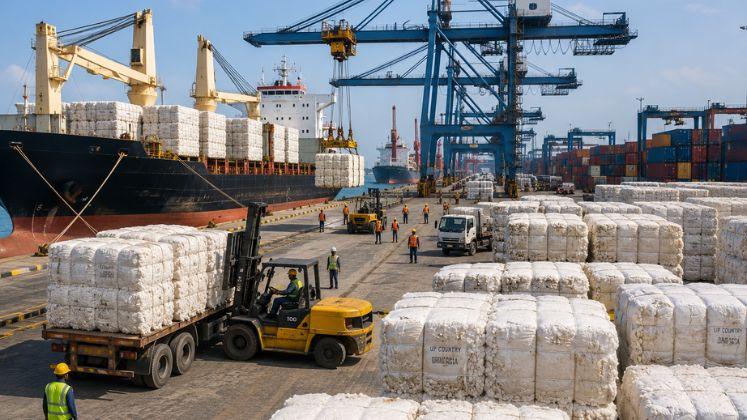
India’s cotton carry-forward stocks for the 2026-27 season are projected to rise by around 42% to more than 85 lakh bales, driven by a sharp increase in imports following the government’s decision to exempt cotton imports from duty, according to investment advisory firm Kedia Advisory.
The increase in imports is expected to improve cotton availability and strengthen opening stocks for the next season, providing greater raw material security for the domestic textile industry.
According to the Cotton Association of India (CAI), cotton imports during the 2025-26 marketing season are now expected to reach 60-65 lakh bales of 170 kg each, significantly higher than its earlier estimate of 47 lakh bales. By the end of May, imports had already reached 43.5 lakh bales, representing a nearly 32% increase compared with the same period a year earlier. Market participants expect an additional 15 lakh bales to arrive following the duty exemption.
As a result, India’s carry-forward stocks at the start of the 2026-27 season in October are estimated at 85.59 lakh bales, compared with an estimated 60 lakh bales in the previous season, marking an increase of around 42%.
CAI has maintained its cotton production estimate for the 2025-26 season at 334 lakh bales. Cotton pressing stood at 322.35 lakh bales as of the end of May, while exports for the season are estimated at 10 lakh bales.
Textile mills continue to favour imported cotton despite near parity between domestic and international prices. Industry participants attribute this preference to superior yarn realisation from imported fibre, which is estimated to be around 4% higher. Yarn produced using imported cotton also commands a premium of nearly Rs. 7 (US $0.074) per kilogram in the market, making imported fibre more attractive for spinning mills.
As of the end of May, total cotton stocks in the country were estimated at 191.44 lakh bales. Of this, mills held approximately 82 lakh bales, while the remaining stocks were held by the Cotton Corporation of India, traders, ginners and multinational companies.
The higher level of imports is expected to significantly strengthen cotton availability in the domestic market, support the textile sector’s demand for quality raw material and improve supply security heading into the 2026-27 season.
- Core Fashion & Textile Value Chain
- Circularity, Sustainability & Waste Management
- Sustainability Enablers & Solutions
- Technology, Platforms & Innovation
- Retail, Trade & Market Access
- Knowledge, Institutions & Ecosystem Builders
- Finance, Investment & Support
- Logistics, Infrastructure & Operations
- Media, Communication & Culture
- Others

 English
 Arabic
 French
 Spanish
 Portuguese
 Deutsch
 Turkish
 Dutch
Dutch
 Italiano
 Russian
 Romaian
 Greek
Greek