


Tirupur Textile Units Accelerate Transition to PNG Amid LPG Shortage
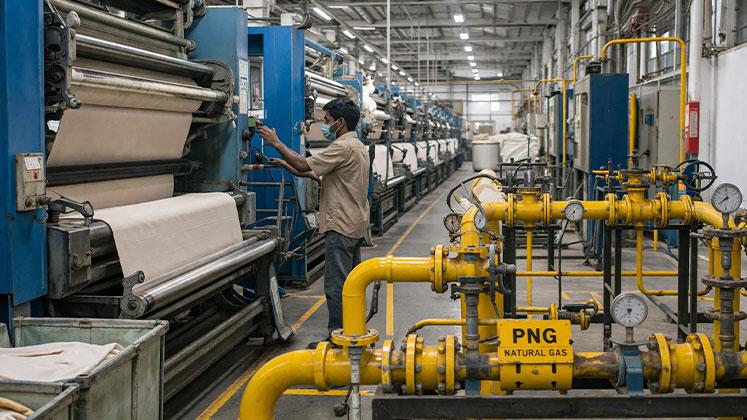
Textile manufacturers in Tirupur are accelerating their transition to piped natural gas (PNG) as an ongoing shortage of liquefied petroleum gas (LPG) continues to disrupt operations and drive up production costs in India’s key knitwear hub.
The shift comes in response to supply constraints triggered by geopolitical tensions in the Middle East, which have significantly impacted the availability and pricing of LPG—an essential fuel for textile processing units.
Industry stakeholders have indicated that production costs have risen by nearly 15% due to escalating energy expenses, further straining margins in an already competitive export environment.
During a recent industry interaction organised by the Tiruppur Exporters’ Association (TEA) in collaboration with Adani Total Gas, TEA President K. M. Subramanian stated that gas connectivity would become a critical requirement for textile units in the near future. He noted that infrastructure providers are prepared to expedite the rollout of PNG in the region to support the industry’s transition.
Industry representatives emphasised that the move towards PNG is not merely a temporary response to fuel shortages but a strategic shift aligned with evolving global sustainability standards. They pointed out that tightening environmental, social and governance (ESG) norms—particularly in export markets—are increasingly requiring cleaner and more traceable production processes.
Kumar Duraiswami, Joint Secretary of TEA, highlighted that PNG adoption is becoming a long-term necessity for the industry, especially as international regulations such as Digital Product Passport (DPP) frameworks are expected to mandate greater transparency and sustainability compliance across textile supply chains.
PNG is being viewed as a more reliable and environmentally sustainable alternative to LPG, offering improved supply stability and helping exporters maintain consistency in production schedules. Industry players believe that this transition will not only mitigate current operational disruptions but also enhance the global competitiveness of Tirupur’s textile sector.
- Core Fashion & Textile Value Chain
- Circularity, Sustainability & Waste Management
- Sustainability Enablers & Solutions
- Technology, Platforms & Innovation
- Retail, Trade & Market Access
- Knowledge, Institutions & Ecosystem Builders
- Finance, Investment & Support
- Logistics, Infrastructure & Operations
- Media, Communication & Culture
- Others

 English
 Arabic
 French
 Spanish
 Portuguese
 Deutsch
 Turkish
 Dutch
Dutch
 Italiano
 Russian
 Romaian
 Greek
Greek