


From kala cotton to banana fibre: How homegrown brands are innovating Indian textiles
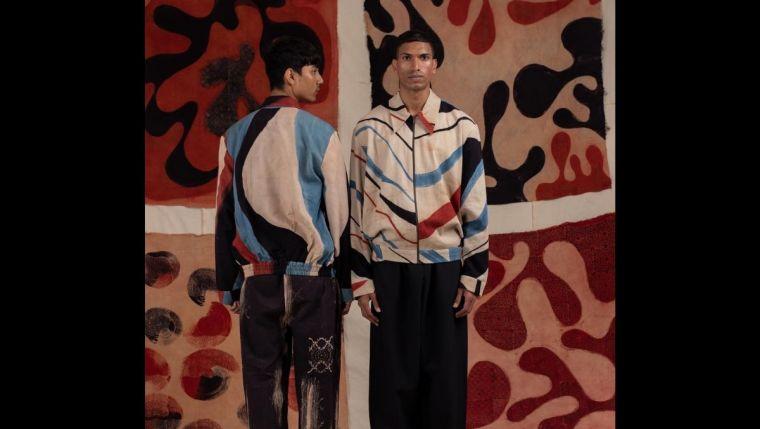
Indian handlooms are experiencing a significant revival, as homegrown brands reimagine traditional textiles into modern fashion while prioritising sustainability.
While the term handloom, in India, still evokes the image of our mothers' saris, beautiful Benarsi silk, intricate jamdani on muslin, or Chanderi and Kota Doria, many homegrown brands are now pushing the envelope, reimagining and repackaging India's rich tradition into newer articles and silhouettes. And everything from the simple trousers, shirts, and dresses to accessories, tote bags, and even scrunchies is on the table. Taking forward the tradition and catering to the modern consumer while keeping the environment in mind appears to be the key.
This is evident at Weave the Future, an exhibition presented by the Ministry of Textiles, which brings together farmers, weavers, handloom artisans, brands, and textile initiatives at Delhi’s National Craft Museum. Launched on National Handloom Day (Thursday), the exhibition runs until August 17.
From Kutch to Pune via Bhopal
While it's understood that India's weavers, spread all across the country, are largely settled in smaller towns and villages, several brands are working with weaver clusters, working with both well-known and lesser-known fabrics, weaving techniques, and embroideries.
Gujarat's Kutch-based brand Varso, run by 26-year-old Komal Baldaniya, is one example. The brand works with kala, or black, cotton, a once-forgotten, drought-resistant, coarse crop, which is now seeing a revival, thanks to brands like Varso and Khamir, a Bhuj-based craft organisation.
"The fabric is rain-fed, doesn't need any more water or pesticides," says Baldaniya, who explains that it's called kala (black) cotton because of the dark-coloured seed that ends up on the end product. In an interesting take, her brand also focuses on the little-known Soof embroidery done by the Meghwal community of Kutch.
"The specialty of this embroidery is that it doesn't require a stencil, or an embroidery ring, and is done on the back," she explains, as she showcases the kala cotton dresses with Soof embroidery she has brought with her from Gujarat.
Not only reviving forgotten fabrics, brands are also working on traditional techniques like eco-printing. They're using ingredients like leaves, turmeric, and saffron to offer striking shades to garments.
Homegrown brands are also working with interesting fabrics. For example, Pune-based re.kala's Kalamkari collection has dresses made with banana fibre and cotton, and another made with orange peel. "Most of the designs are zero waste, and if not, we use fibre in accessories like tote bags and scrunchies," says founder Shweta Deshmukh. "And even smaller scraps are converted into paper and paintings," she adds.
On the growing number of brands working in the handloom space, she says, "We've looked towards the West for far too long, and now we have started looking inwards."
Here, the Kolkata-based brand Love For The Loom by Sonali Bhattacharya stands out as it showcases its beautiful collection of jamdani on muslin saris, which look straight out of a Bengali classic. Its Ganga Jamuni collection is an ode not only to India's composite culture, but it also maps the regions that fall on the course of the Ganga. "Faizabad, in Uttar Pradesh, has been a major centre of Jamdani weaving," she points out.
India's handloom potential
Notably, about 35.22 lakh households are involved in the handloom sector. Not just that, over 70% of the handloom weavers are women, according to the 4th All India Handloom Census (2019–20). India's textile industry continues to command global demand, too. For example, in FY 2024-25, the United States, the largest destination of Indian textiles, accounted for Rs 331.56 crore worth of exports. With much potential in store, and brands increasingly taking interest, it's interesting to witness where India's handlooms are headed.
- Core Fashion & Textile Value Chain
- Circularity, Sustainability & Waste Management
- Sustainability Enablers & Solutions
- Technology, Platforms & Innovation
- Retail, Trade & Market Access
- Knowledge, Institutions & Ecosystem Builders
- Finance, Investment & Support
- Logistics, Infrastructure & Operations
- Media, Communication & Culture
- Others

 English
 Arabic
 Spanish
 Portuguese
 Deutsch
 Turkish
 Dutch
Dutch
 Italiano
 Russian
 Romaian
 Portuguese (Brazil)
 Greek
Greek