


Bangladesh’s $45 billion MMF opportunity begins where cotton reaches its limit
Key Insights
- Bangladesh's next export growth will depend more on expanding MMF than increasing cotton garment production.
- Capturing just 12% of the global MMF market could add nearly $45 billion in annual apparel exports by 2030.
- LDC graduation makes diversification urgent, as higher-value MMF products can better absorb future tariff pressures than basic cotton apparel.
- A competitive domestic MMF supply chain will require $25–30 billion in investment across fibers, yarn, fabrics and advanced textile processing.
- The race for global MMF leadership will be decided by investment, technology, policy reform and sustainability—not manufacturing capacity alone.
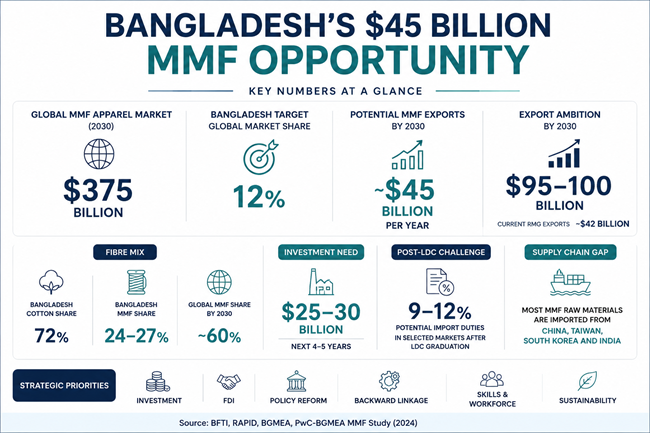
For decades, cotton has been the backbone of Bangladesh's apparel success. International brands are sourcing more activewear, sportswear, outerwear and technical garments made from man-made fibers (MMF), creating a market that Bangladesh cannot afford to overlook. According to the Bangladesh Foreign Trade Institute (BFTI), the global MMF apparel market could reach $375 billion by 2030, offering Bangladesh a rare opportunity to reshape its export future.
The opportunity is significant because global demand is changing faster than Bangladesh's production mix. According to the PwC-BGMEA MMF Study (2024), man-made fibers already account for more than half of global apparel trade, and their share is expected to approach 60% by 2030. Bangladesh, however, remains heavily dependent on cotton, with around 72% of its apparel exports made from cotton while only 24–27% come from MMF, according to BFTI and BGMEA. This gap explains why the country's next phase of export growth depends less on producing more garments and more on producing the right garments.
The shift toward MMF is driven by changing consumer preferences rather than fashion alone. Global brands are therefore expanding sourcing of products that rely on polyester, nylon, viscose, and blended fibers. According to BFTI, if Bangladesh captures 12% of the projected $375 billion MMF apparel market by 2030, it could generate nearly $45 billion in annual MMF exports. Combined with continued growth in cotton apparel, this could lift the country's total RMG exports to $95–100 billion by the end of the decade.
The urgency has increased because Bangladesh is approaching a major trade transition. Following its graduation from Least Developed Country (LDC) status, exporters will gradually lose several preferential market benefits. According to BFTI, apparel exports to many markets could face average import duties of 9–12%, while the European Union's EBA facility will provide temporary support until 2029. Higher tariffs will put additional pressure on basic cotton products that already operate with narrow margins. Higher-value MMF apparel offers stronger pricing opportunities and can help exporters remain competitive in a post-LDC environment.
Despite having one of the world's strongest garment manufacturing industries, Bangladesh still lacks a competitive MMF supply chain. Most polyester staple fiber, viscose, synthetic yarn and advanced fabrics are imported from China, Taiwan, South Korea and other suppliers. This dependence increases lead times, raises logistics costs and limits manufacturers' ability to respond quickly to buyers. According to Research and Policy Integration for Development (RAPID) and BFTI, Bangladesh requires $25–30 billion in new investment over the next four to five years to build domestic capacity in polyester, PET chips, synthetic yarn, filament production and advanced dyeing.
Mobilizing capital at this scale presents a structural challenge. Synthetic textile manufacturing is vastly more capital-intensive than cotton assembly, requiring long-term financing models, blended private-public funding, and targeted foreign capital. Furthermore, synthetic fiber production and continuous-dyeing technology require high volumes of uninterrupted industrial power and gas. Ensuring energy security, grid reliability, and competitive utility pricing will be a vital precondition for unlocking domestic MMF manufacturing at scale.
Investment alone will not be enough without supportive policies. Industry leaders have recommended lower import duties on MMF raw materials, easier bonded warehouse facilities, dedicated financing for synthetic textile projects, and targeted export incentives to encourage investment in non-cotton apparel.
At the same time, attracting foreign direct investment from countries such as South Korea, Taiwan, and Japan can accelerate technology transfer in fiber production, recycling, and technical textiles. Building a skilled workforce for synthetic fabrics will also be essential, as MMF manufacturing requires fundamentally different production techniques, thermal management, and precision chemistry compared to conventional cotton garments.
Sustainability will shape the industry's long-term competitiveness as well. Although polyester remains the fastest-growing fiber, global brands are facing stringent regulatory frameworks, such as the European Union’s Ecodesign for Sustainable Products Regulation (ESPR) and circular economy directives. Demand for recycled polyester, traceable supply chains, and low-impact processing is rising rapidly.
The coming five years will therefore be decisive. What it now needs is a stronger synthetic textile ecosystem supported by capital investment, reliable energy infrastructure, policy reform and technology. If those pieces come together, the country's ambition to secure a meaningful share of the $375 billion global MMF market will become more than an export target. It will mark the beginning of Bangladesh's next industrial transformation, taking its apparel industry beyond cotton and into a more diversified, resilient and higher-value future.
- Core Fashion & Textile Value Chain
- Circularity, Sustainability & Waste Management
- Sustainability Enablers & Solutions
- Technology, Platforms & Innovation
- Retail, Trade & Market Access
- Knowledge, Institutions & Ecosystem Builders
- Finance, Investment & Support
- Logistics, Infrastructure & Operations
- Media, Communication & Culture
- Others

 English
 Arabic
 French
 Spanish
 Portuguese
 Turkish
 Dutch
Dutch
 Italiano
 Russian
 Romaian
 Portuguese (Brazil)
 Greek
Greek