


EU launches sustainable textile working group to tackle crisis and drive circular reform
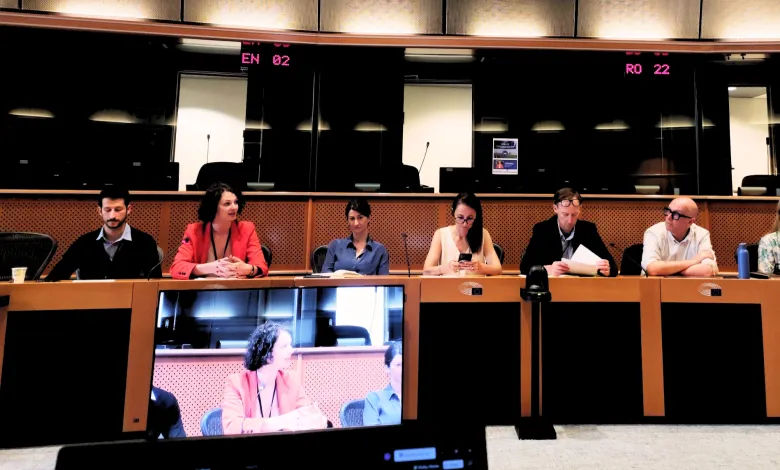
In a significant milestone for the European textile sector, the official launch of the European Parliament’s Sustainable Textile Working Group brought together policymakers, social enterprises, and civil society to confront one of the region’s most urgent sustainability and social equity challenges: the transformation of the textile industry into a fair and circular system.
Co-hosted by MEPs Saskia Bricmont, Barry Andrews, and Lara Wolters, the event convened key civil society players including RREUSE, Changing Markets Foundation, Clean Clothes Campaign, Fashion Revolution, Fair Trade Advocacy Office, ECOS, the European Environmental Bureau, and industriAll Europe to chart a course for Europe’s textile transition.
A Crisis in the Making: Reuse Sector Under Siege
The celebratory tone of the group’s formation was tempered by sobering realities on the ground. According to a February 2025 policy paper by RREUSE, social enterprises operating in the reuse and recycling of textiles are being squeezed to the brink of collapse. The causes? An unsustainable influx of low-quality fast fashion, overproduction driven by digital retail, rising operational costs, and the absence of stable policy frameworks to fund textile waste management systems.
Despite the EU’s 2025 mandate for separate textile waste collection, operators face a yawning funding gap. Without mandatory Extended Producer Responsibility (EPR) schemes in full operation across member states, the cost of textile recovery falls heavily on nonprofits and social enterprises. In countries where EPR is already in place, such as France and the Netherlands, current systems have failed to curb the flood of discarded garments or equitably fund social sector engagement.
A Call to Recognize Social Enterprises as Central Actors
The new working group offers hope by pledging to include these on-the-ground actors in shaping EU textile policy. At the event, RREUSE and its coalition partners urged MEPs to support a package of targeted measures:
- Emergency funding mechanisms to prevent further closures of sorting and reuse facilities.
- EPR frameworks that prioritize waste prevention and reuse before recycling.
- Inclusive governance structures that give social enterprises a formal voice in EPR management.
- Local reuse prioritization under the proximity principle to reduce export burdens.
Each tonne of textiles managed by a social enterprise has the potential to create 20–35 jobs—often for individuals facing social exclusion—highlighting the dual environmental and social dividend at stake.
The Policy Blueprint: Ambition with Accountability
The October 2024 policy recommendations developed by the same civil society coalition push even further. Centered on three pillars that are “What’s in my clothes,” “Who made my clothes,” and “How my clothes are sold”—the roadmap offers a comprehensive reform agenda for the new EU legislative cycle.
Key proposals include:
- Binding material footprint targets for textiles by 2030, 2040, and 2050.
- Ecodesign standards mandating durability, repairability, and minimal environmental toxicity.
- A ban on the destruction of unsold or returned garments.
- Mandatory transparency on supply chains, working conditions, and production volumes.
- Incentives for fashion brands to decarbonize their supply chains without penalizing Global South suppliers.
The document also calls out greenwashing and social-washing as systemic risks that must be curbed through pre-market verification of environmental claims, clearer labeling, and regulation of misleading advertising.
Europe’s Textile Future: Inclusive, Just, and Circular?
As the Sustainable Textile Working Group begins its mandate, momentum is building around the idea that sustainability in textiles must be about more than emissions or waste targets—it must ensure equity and economic dignity.
With 12.6 million tonnes of textile waste generated annually in the EU and a growing share being exported or incinerated, the need for robust, inclusive policies has never been greater.
RREUSE and its allies see this working group as a critical platform to reshape Europe’s textile industry into one that values reuse, respects workers, and regenerates resources. Whether the EU can match its rhetoric with regulation will be the true test of its textile transformation.
- Core Fashion & Textile Value Chain
- Circularity, Sustainability & Waste Management
- Sustainability Enablers & Solutions
- Technology, Platforms & Innovation
- Retail, Trade & Market Access
- Knowledge, Institutions & Ecosystem Builders
- Finance, Investment & Support
- Logistics, Infrastructure & Operations
- Media, Communication & Culture
- Others

 English
 Arabic
 French
 Spanish
 Portuguese
 Deutsch
 Dutch
Dutch
 Italiano
 Russian
 Romaian
 Portuguese (Brazil)
 Greek
Greek