


Fashion Roundtable Proposes Strategic Use of Public Procurement to Revitalize UK Manufacturing Share
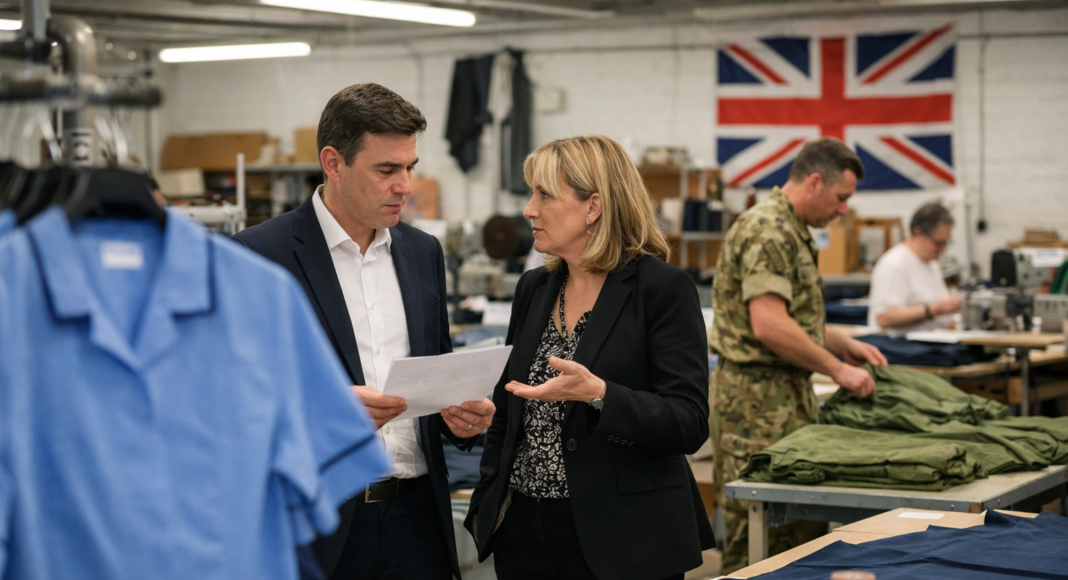
Fashion Roundtable has issued an open letter to the UK’s Prime Minister, Andy Burnham, calling for the strategic use of public procurement to rejuvenate the domestic textile and garment production sector. The correspondence, sent ahead of the finalization of the ‘Number 10 North’ initiative, suggests that government contracts for textile goods should prioritize suppliers that manufacture within the United Kingdom. The proposal specifically identifies NHS uniforms and defense apparel as primary categories for this shift.
The organization asserts that public procurement serves as a highly effective and immediate mechanism for supporting domestic production. By focusing on local contracts, the government can facilitate regional job creation and fulfill broader objectives regarding reindustrialization and decentralization. Fashion Roundtable maintains that consistent government orders provide the long-term stability necessary for factories to invest in infrastructure, retain skilled personnel, and solidify regional supply chains.
Expanding UK Textile Manufacturing Through Policy Reform
The letter references an April 2026 report titled ‘Policy Fragmentation and Place-Based Opportunity in the UK Fashion and Textiles,’ which was developed in collaboration with the Local Policy Innovation Partnership Hub at the University of Birmingham. This research highlights that directing public textile contracts toward UK manufacturers offers a significant opportunity to bolster regional resilience and inclusive economic growth.
A core argument presented is that the current difficulties facing the industry do not stem from a lack of technical capability. Instead, the sector suffers from fragmented policymaking. Because fashion and textiles are positioned between the creative industries and the manufacturing sector, they often lack the coordinated support found in other industries. Fashion Roundtable argues that public procurement can bridge this gap by acting as a foundational industrial policy tool.
Specific Proposals for Onshoring and Governance
To address these issues, Fashion Roundtable has recommended two primary actions. The first is the implementation of formal onshoring requirements for public textile contracts. This would ensure that products such as NHS uniforms and military gear are produced within the country.
Secondly, the organization is calling for the creation of a dedicated manufacturing and textiles task force. This body would be responsible for coordinating policy across several departments, including the Ministry of Defence, the Department of Health and Social Care, and the Department for Business and Trade. Furthermore, Fashion Roundtable has requested a formal meeting with the Prime Minister before the Manchester-based Number 10 North programme is finalized, noting the initiative’s goal to drive local economic growth.
The letter also cites findings from the July 2026 Covid Inquiry, which noted that approximately £10 billion in public funds was spent on unsuitable or excess overseas PPE during the pandemic. This serves as a cautionary example of the risks associated with a heavy reliance on offshore manufacturing at the expense of domestic capacity.
The Role of British Industry in Future Government Spending
The focus on public procurement aligns with a growing political emphasis on domestic production. Data indicates that UK manufacturing and supply chain resilience were discussed over 100 times in Parliament during the second quarter of 2026. Government officials have signaled an intent to increase spending with small and medium-sized enterprises (SMEs), with targets reaching over £7 billion annually by 2028.
Recent legislative discussions have highlighted that government spending, which totals roughly £400 billion each year, should be leveraged to deliver better outcomes for British industry and local communities. Current reforms aim to simplify access to government contracts while strengthening social value requirements.
Fashion Roundtable is currently seeking industry-wide support for its proposals. If the government adopts these measures, it would place domestic production at the heart of state purchasing, potentially serving as a catalyst for long-term UK textile manufacturing growth.
- Core Fashion & Textile Value Chain
- Circularity, Sustainability & Waste Management
- Sustainability Enablers & Solutions
- Technology, Platforms & Innovation
- Retail, Trade & Market Access
- Knowledge, Institutions & Ecosystem Builders
- Finance, Investment & Support
- Logistics, Infrastructure & Operations
- Media, Communication & Culture
- Others

 English
 Arabic
 French
 Spanish
 Portuguese
 Deutsch
 Turkish
 Dutch
Dutch
 Italiano
 Romaian
 Portuguese (Brazil)
 Greek
Greek