


KARL MAYER Sees Strong Demand For Warp Preparation Technology Amid AI-Driven CCL Boom
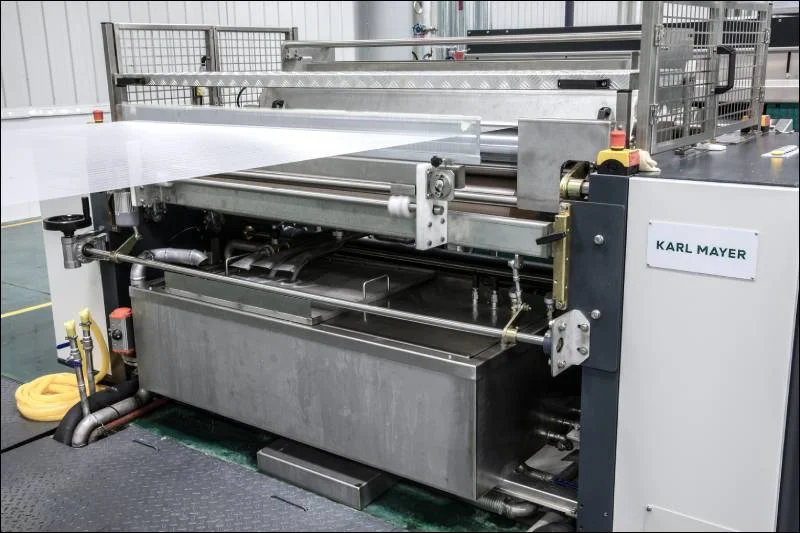
The rapid expansion of artificial intelligence (AI) is driving unprecedented demand for copper-clad laminates (CCLs), a key material used in the production of printed circuit boards (PCBs) that form the backbone of AI infrastructure. As CCLs are typically reinforced with woven glass fabrics, the trend is creating significant opportunities for KARL MAYER’s Warp Preparation Business Unit.
According to the company, the growing requirement for high-quality glass fabrics has translated into strong order intake for its warp preparation solutions.
“Currently, around four billion meters of glass fabric are produced worldwide each year. By 2028, another two billion meters will be added – a massive market in which we lead with a major market share,” said *Enzo Paoli, President of Warp Preparation Business Unit at KARL MAYER.
KARL MAYER attributes its market position to its specialised product portfolio, including the FILSIZE-G sizing machine and AM-G assembling machine. Designed for glass fabric production, the systems offer high process reliability, productivity and consistent warp quality, even during frequent product changes.
The company’s journey in the electronic glass segment began in 2007 with initial deliveries to customers in China and Taiwan. Continuous advancements in warp preparation technology helped establish its solutions as an industry standard, culminating in the sale of its 100th machine for electronic glass applications in China in 2020.
The rise of AI is also increasing the complexity of PCB manufacturing. While standard electronic products typically use six-layer CCLs, electric vehicles and smartphones require around 12 layers, and AI data centres increasingly rely on PCBs with more than 24 layers. This has significantly increased demand for precision-engineered glass fibre fabrics.
As manufacturers work with more advanced materials and complex structures, precise yarn tension control during warp preparation has become critical. Even minor variations can lead to density differences in the fabric, causing signal transmission issues in high-frequency applications, commonly referred to as the fibre-weave effect or intra-pair skew.
KARL MAYER believes its expertise and technology portfolio position the company to benefit from the continued expansion of AI infrastructure worldwide.
“While AI is shaping the digital future, KARL MAYER is providing the technology that lays the foundation for it today.”
- Core Fashion & Textile Value Chain
- Circularity, Sustainability & Waste Management
- Sustainability Enablers & Solutions
- Technology, Platforms & Innovation
- Retail, Trade & Market Access
- Knowledge, Institutions & Ecosystem Builders
- Finance, Investment & Support
- Logistics, Infrastructure & Operations
- Media, Communication & Culture
- Others

 English
 Arabic
 French
 Spanish
 Portuguese
 Deutsch
 Turkish
 Dutch
Dutch
 Italiano
 Russian
 Romaian
 Portuguese (Brazil)