


Trump’s Latest Tariffs on India, 59 Others Face Fresh Legal Challenge in US Court
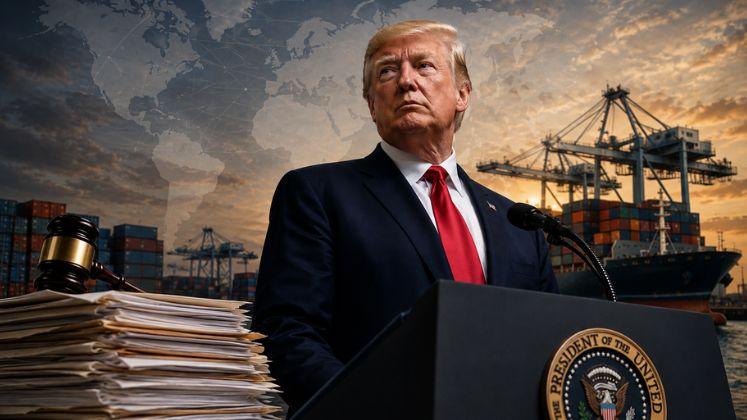
US President Donald Trump’s latest tariff measures have come under fresh legal scrutiny after a coalition of 25 Democratic-led US states filed a lawsuit challenging the new import duties imposed on 60 trading partners, including India.
The lawsuit, filed on Monday in the US Court of International Trade in New York, contests tariffs ranging from 10% to 12.5% that came into effect last month under Section 301 of the Trade Act of 1974. The Trump administration has justified the duties as a response to countries that have failed to curb exports of goods produced using forced labour.
The states argue that the administration is exceeding its legal authority by using Section 301 to impose broad-based tariffs, despite previous court rulings limiting the President’s power to levy sweeping import duties.
According to the complaint, Section 301 has historically been used to address unfair trade practices by specific countries or industries, not to impose tariffs on a wide range of imports.
The lawsuit also alleges that the administration is using forced labour concerns as a pretext to reintroduce tariffs that had previously been struck down by the courts.
The disputed tariffs were announced on July 24 and apply to imports from 60 trading partners, including India and the European Union. India’s tariff rate was reduced to 10% from the initially proposed 12.5% after the country strengthened enforcement measures, according to a senior administration official.
Several categories of imports, including oil, natural gas, fertilisers and products eligible for duty-free treatment under the US-Mexico-Canada Agreement (USMCA), have been exempted from the new tariffs.
Defending the move, US Trade Representative Jamieson Greer said the United States has enforced a ban on imports made with forced labour for nearly a century and that its trading partners should adopt similar standards.
The latest action marks another chapter in the legal battle over Trump’s tariff policy. Earlier this year, the US Supreme Court ruled that the International Emergency Economic Powers Act (IEEPA) did not grant the President authority to impose sweeping global tariffs.
Subsequent tariffs introduced under Section 122 of the Trade Act of 1974 also faced legal setbacks and remain under appeal.
The administration has now shifted to Section 301, the same provision used during Trump’s first term to impose targeted tariffs on China, in an effort to sustain its broader trade strategy while ongoing legal challenges continue.
- Core Fashion & Textile Value Chain
- Circularity, Sustainability & Waste Management
- Sustainability Enablers & Solutions
- Technology, Platforms & Innovation
- Retail, Trade & Market Access
- Knowledge, Institutions & Ecosystem Builders
- Finance, Investment & Support
- Logistics, Infrastructure & Operations
- Media, Communication & Culture
- Others
 Portuguese
 English
 Arabic
 French
 Spanish
 Deutsch
 Turkish
 Dutch
Dutch
 Italiano
 Russian
 Romaian
 Portuguese (Brazil)
 Greek
Greek