


US Forced Labour Tariffs Raise Compliance Challenge for India’s Garment Exports
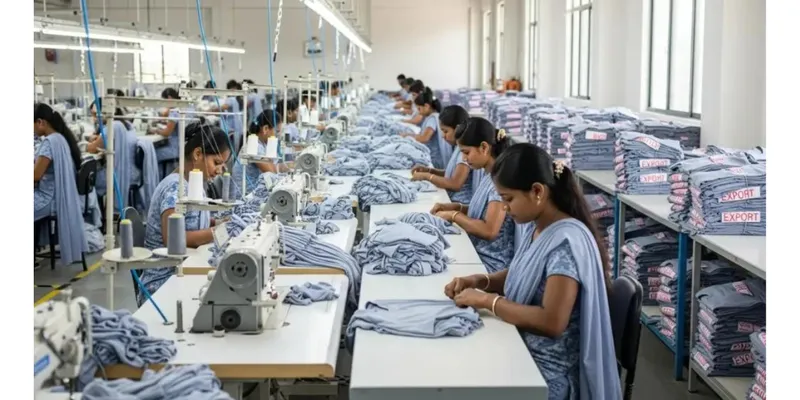
New Section 301 measures may increase compliance costs, impact sourcing decisions and intensify traceability requirements for Indian apparel exporters.
The United States' proposed 12.5% "forced labour" tariffs are expected to create fresh compliance obligations for India's textile and readymade garment (RMG) exporters, even though the measure is unlikely to provide India with a competitive advantage over key apparel-exporting countries.
The proposed tariff applies to countries including Vietnam, Bangladesh, Malaysia and Thailand, while Indonesia is expected to receive only limited relief through a lower 10% tariff. As a result, the relative competitive position among major Asian apparel exporters is expected to remain largely unchanged.
Industry estimates indicate that the new compliance requirements could reduce operating margins for textile and garment exporters by 8–10%. Margins in the sector typically range between 5% and 8%, making additional compliance costs a significant consideration, although exporters in premium product segments may experience relatively lower pricing pressure.
The proposed measure, introduced under Section 301 of the US Trade Act, is expected to lead to temporary pauses in sourcing decisions by major US retailers. Industry estimates suggest production costs could increase by 3–5% due to stricter compliance requirements.
Exporters may face additional costs related to certifications, audits, testing, documentation, digital tracking systems and supply chain verification. These expenses could account for 1% to 5% of an export order's value, with smaller exporters expected to bear a proportionately higher burden.
Industry executives noted that US buyers, who typically operate under tight pricing structures, are unlikely to absorb the higher compliance costs. As a result, exporters may need to manage the impact through lower margins, except in selected niche product categories.
Current traceability systems may also require further strengthening. Under the proposed framework, importers will need to demonstrate that their supply chains are free from forced labour.
Ajay Sahai, Director-General of the Federation of Indian Export Organisations (FIEO), said:
"Only about 25-30% of Indian apparel export consignments currently carry formal fibre-traceability certifications," said Ajay Sahai, director-general of the Federation of Indian Export Organisations (FIEO). "These are largely driven by requirements imposed by global brands and large retailers rather than industry-wide standards."
The level of dependence on Chinese inputs varies across product categories. For cotton apparel, the impact is expected to be limited because India remains largely self-sufficient in cotton-based raw materials. However, Chinese-origin inputs continue to play a significant role in synthetic blended textiles, speciality yarns, performance fabrics, trims and embellishments, where Chinese content is estimated at 12–15%.
India imported nearly US$3.8 billion worth of yarns, fabrics and related textile inputs from China in FY26, compared with apparel exports of US$15.8 billion. While these imports indicate continued sourcing dependence, a substantial share supports domestic production in segments such as home textiles and technical textiles.
Industry representatives also highlighted that India has yet to fully diversify and strengthen its man-made fibre ecosystem, resulting in continued dependence on imported synthetic textile inputs.
The proposed tariff follows earlier US actions restricting imports linked to forced labour in China's Xinjiang region. While some global retailers shifted sourcing to countries including India, Vietnam and Bangladesh under the "China+1" strategy, industry representatives said the gains have not significantly altered India's export position.
India's apparel exports reached US$15.8 billion in FY26, showing limited change from FY25 and remaining only slightly above FY20 levels. The United States' share in India's textile and clothing exports has remained broadly stable at 25–26%, increasing to around 30–32% in the garment segment. Readymade garment exports to the US declined from US$5.3 billion in FY22 to US$4.8 billion in FY26.
According to Sanjai, the proposed 12.5% tariff could prompt US retailers to review their sourcing strategies. India faces greater exposure in synthetic textiles, where exporters may need to demonstrate that Chinese-origin intermediate materials are not linked to sanctioned regions or entities.
Consumer-facing categories such as garments, home furnishings, bed linen and towels are expected to receive greater scrutiny because they move directly into the US retail market.
Cotton-based exports may remain relatively less affected due to stronger farm-to-fabric traceability systems in organic cotton supply chains. However, traceability for conventional cotton remains more complex because of India's fragmented farming structure and multi-layered mandi system.
Large integrated textile companies and leading exporters have already begun expanding traceability initiatives, including blockchain-based tracking, DNA tagging and isotopic testing, to establish fibre origin and comply with emerging sourcing requirements. Compliance frameworks such as the Global Organic Textile Standard (GOTS) and recycled-content certification are also expected to become increasingly important.
Prabhu Damodharan, Convenor of the Indian Texpreneurs Federation, said:
"India should seek maximum relief through the proposed bilateral trade agreement with the US, which could provide a meaningful competitive advantage. At the very least, tariff treatment should remain aligned with competing countries," he said.
Manoj Sethi, Managing Director of Surat-based Ginza Industries, said:
"Nylon and polyester filament yarns are mostly imported from China. At present, there is no robust mechanism to establish whether forced labour has been used in their production," he said.
In FY26, the United States accounted for 55.6% of India's carpet exports, 43.9% of made-ups and home furnishings exports, 34.8% of laminated industrial textile exports, 30.9% of knitted apparel exports, and 30.2% of non-knitted apparel exports, underlining the market's continued importance for India's textile sector.
- Core Fashion & Textile Value Chain
- Circularity, Sustainability & Waste Management
- Sustainability Enablers & Solutions
- Technology, Platforms & Innovation
- Retail, Trade & Market Access
- Knowledge, Institutions & Ecosystem Builders
- Finance, Investment & Support
- Logistics, Infrastructure & Operations
- Media, Communication & Culture
- Others

 English
 Arabic
 French
 Spanish
 Portuguese
 Deutsch
 Turkish
 Dutch
Dutch
 Italiano
 Romaian
 Portuguese (Brazil)
 Greek
Greek