


Source Fashion's report reveals fashion's overproduction crisis
Insights
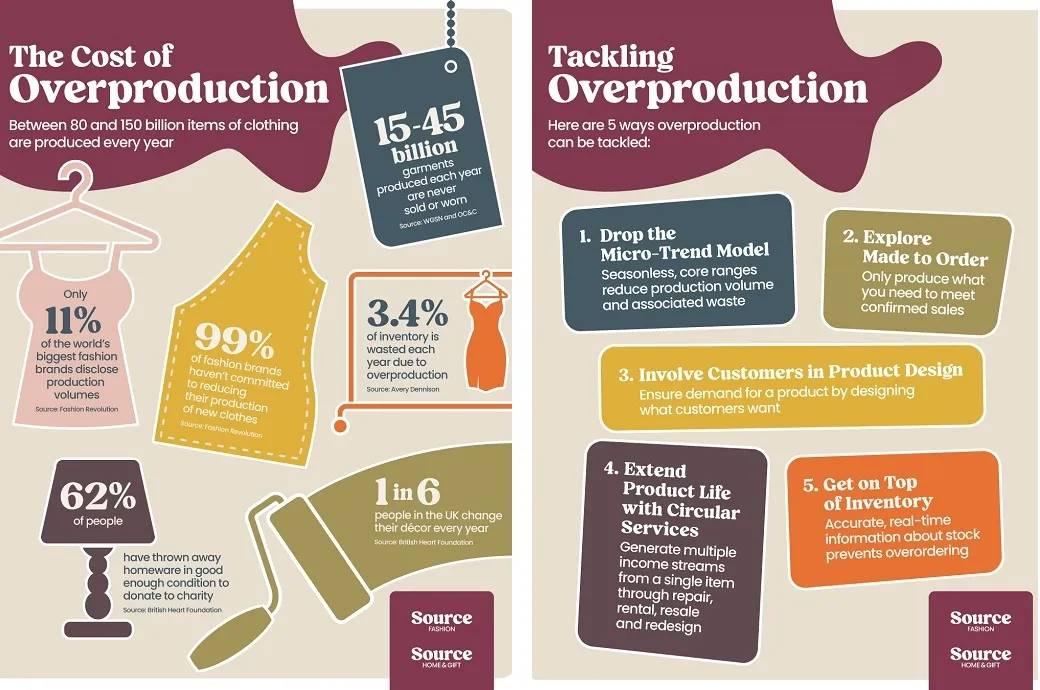
- Source Fashion's new report, Do We Really Need to Produce So Much?, reveals fashion's overproduction crisis—80–150 billion garments made yearly, with up to 40 per cent unsold.
- It urges brands to adopt on-demand production, circular design, resale, and co-creation to cut waste and boost margins.
- The report calls for a shift to smarter, leaner, and more sustainable models.
Source Fashion, the leading destination for responsible sourcing and fashion innovation, has launched a landmark report tackling one of the fashion industry’s most pressing but least addressed issues: overproduction.
Titled “Do We Really Need to Produce So Much?”, the report—developed in collaboration with retail futures consultancy Insider Trends—offers a data-rich exploration of the scale, causes, and consequences of overproduction. It presents forward-thinking solutions for brands looking to remain competitive while reducing waste and environmental impact. The full report is now available for download at Source Fashion – Overproduction Report 2025.
Overproduction: A Costly and Widespread Issue
The report reveals that the global fashion industry produces between 80 and 150 billion garments annually—yet up to 40% remain unsold, frequently ending up in landfill, incineration, or markdown bins. Despite the environmental and financial toll, only 1% of fashion brands are actively working to reduce production volumes.
A New Blueprint for Fashion
Rather than simply highlighting the problem, the report presents actionable models already being piloted by leading brands and retailers:
- On-Demand Production – Producing only what is needed, when it’s needed, to eliminate excess stock.
- Circular Design – Creating garments designed to be reused, repaired, or recycled, thereby extending their lifecycle.
- Retail-as-a-Service – Shifting from ownership to access models such as rental, resale, and subscription.
- Collaborative Creation – Co-designing with consumers to ensure relevancy and reduce waste.
As the report states, “Brands can reduce production without reducing profit. In fact, in many cases, it increases margins and strengthens consumer trust.” The publication includes case studies from brands already implementing these approaches, demonstrating commercial viability alongside sustainability gains.
A Turning Point for Retail
The report arrives at a pivotal moment for fashion, as the industry faces shifting consumer expectations, economic uncertainty, and growing pressure from both regulators and investors.
Suzanne Ellingham, Sourcing Director at Source said, “This report highlights the uncomfortable truth behind retails success — that excess production is built into the model with volume is the only way to increase profits. As we approach 2025, companies must question not only how they produce, but how much, and how they deal with . There are real over production and excess. Opportunities for those willing to embrace a leaner, smarter, more circular future.”
- Core Fashion & Textile Value Chain
- Circularity, Sustainability & Waste Management
- Sustainability Enablers & Solutions
- Technology, Platforms & Innovation
- Retail, Trade & Market Access
- Knowledge, Institutions & Ecosystem Builders
- Finance, Investment & Support
- Logistics, Infrastructure & Operations
- Media, Communication & Culture
- Others

 English
 French
 Spanish
 Portuguese
 Deutsch
 Turkish
 Dutch
Dutch
 Italiano
 Russian
 Romaian
 Portuguese (Brazil)
 Greek
Greek