


From Root to Reel: How Nature Is Colouring the Future of Textiles
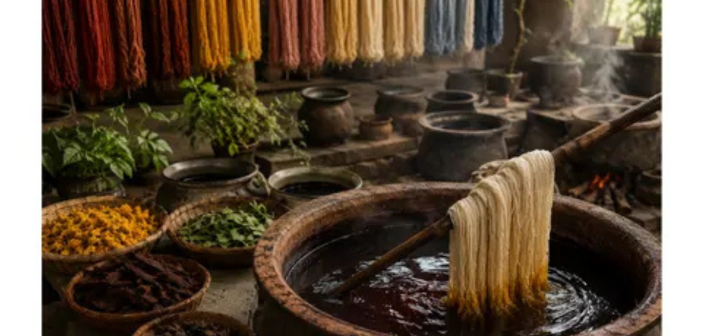
What Are Natural Dyes, and Why Are We Talking About Them Again?
Natural dyes are colourants extracted from plants, animals, and minerals. Think indigo leaves, madder roots, turmeric, pomegranate rind, and even the cochineal insect. They fall under the broader category of sustainable or bio-based colourants, sitting at the intersection of ecological chemistry and textile finishing.
For centuries, every garment on earth was coloured this way. Then the Industrial Revolution brought synthetic dyes: cheap, consistent, scalable. Natural dyes were pushed to the margins. The introduction of synthetic dyes during the Industrial Revolution led to a significant decline in the use of natural dye plants, which became marginalised in industrial applications.
Fast-forward to today: the world is circling back.
The Market: Bigger Than You’d Think
The natural dyes market was valued at USD 5.07 billion in 2024 and is projected to grow to USD 8.95 billion by 2034, at a CAGR of 5.9% (Polaris Market Research) [1], with textiles leading end-use at approximately 44% share in 2024 (Grand View Research, December 2025) [2]. The broader textile dye market is estimated at USD 13.21 billion in 2026 and is expected to reach USD 16.71 billion by 2031 at a CAGR of 4.81% (Mordor Intelligence, February 2026) [3].
What is fuelling this? Consumer pressure, regulation, and brand reputation. A growing consumer preference for eco-friendly and sustainable products drives this shift. According to Roundup [4], 78% of consumers say sustainability is important, and 55% are willing to pay more for eco-friendly brands. Furthermore, 84% of customers indicate that poor environmental practices would alienate them from a brand.
India is a critical player here. India banned 112 azo- and benzidine-based dyes in October 2023, reflecting a global effort to protect public health and the environment. The regulatory floor is rising.
Types of Natural Dyes: How Are They Categorised?
Natural dyes are grouped by three primary sources:
|
Source |
Examples |
Common Textile Use |
|
Plant-based |
Indigo, madder, turmeric, henna, weld |
Cotton, silk, wool |
|
Animal-based |
Cochineal (insect), lac |
Wool, silk |
|
Mineral-based |
Ochre, iron oxides |
Speciality fibres |
Plant-based dyes dominate. The plants segment held a dominant market position in the natural dyes market, with extensive use in textiles, food, and cosmetics.
They are also categorised by how they bond to fabric: substantive dyes (bond directly without help), mordant dyes (which need a metallic salt or plant extract to fix the colour), and vat dyes like indigo (which require a chemical reduction process before dyeing).
The Production Process: Step by Step
This is where things get genuinely interesting, and where the textile industry is innovating fastest.
Step 1 — Raw Material Sourcing
Dye-yielding plants such as indigo, madder, weld, and henna are farmed or wildcrafted. Sustainable sourcing is increasingly governed by regenerative agriculture principles. Brands like Oshadi in India grow cotton and dye plants on the same regenerative farm.
Step 2 — Extraction
The plant material (leaves, roots, bark, or flowers) is dried, crushed, and boiled in water to release the pigment. Extraction of the dye components from plant materials is performed with boiling water, without the addition of chemicals or solvents. More advanced facilities now use ultrasonic extraction and supercritical CO₂ extraction to improve yield without toxic solvents. The use of ultrasound in textile wet-processing applications offers documented benefits in terms of reduced process time, lower energy and chemical consumption, and improved product quality. German manufacturer Hielscher Ultrasonics is among the leading suppliers of industrial-scale ultrasonic processors purpose-built for textile dyeing applications.
Step 3 — Scouring the Fabric
Before dyeing, the fabric must be cleaned (scoured) to remove oils, waxes, and impurities. This opens the fibre and prepares it for dye uptake.
Step 4 — Mordanting
This is the critical fixing step that determines how long the colour lasts. Mordants are substances sourced from nature, such as plant extracts or minerals, that aid in binding the dye to the fabric. Alum, iron, copper, and chrome are common mordants, with alum preferred for its efficacy, safety, and versatility with plant dyes. Today, biomordants like pomegranate peel, amla powder, and harda are replacing metal salts for cleaner production.
Step 5 — Dyeing
The mordanted fabric is submerged in the dye bath, typically at 60 to 100°C, for 45 to 90 minutes, depending on the fibre and depth of colour desired. Cotton, silk, and wool can be dyed with madder at 100°C for 60 minutes, producing bright red shades on wool and silk and a red-violet colour on cotton. Modern low-liquor-ratio machines reduce water use significantly compared to older open-bath systems, addressing one of natural dyeing’s long-standing criticisms around water consumption.
Step 6 — Washing, Drying, and Testing
The fabric is rinsed, excess dye removed, and dried. Colourfastness is then tested against washing, rubbing, and light exposure, increasingly benchmarked to ISO 105 standards. Globally recognised certifications like GOTS (Global Organic Textile Standard) and OEKO-TEX provide third-party validation for natural-dyed fabrics, something brands and buyers now actively demand throughout the supply chain.
The Machines Behind It All
Industrial natural dyeing relies on precision machinery, most of which is now engineered for lower water and energy use. The top dyeing and finishing machinery suppliers dominating the global market in 2025 include Thies (Germany), Benninger (Switzerland), Loris Bellini (Italy), Santex Rimar (Italy), A. Monforts (Germany), Brazzoli (Italy), Sclavos (Greece), and Fong’s (Hong Kong), leading with advanced machinery for jet dyeing, continuous dyeing, and finishing processes, and integrating automation, energy-efficient technologies, and Industry 4.0 solutions. In India, ATE Enterprises is a key distributor of international dyeing machinery and is involved in technology-transfer initiatives to modernise domestic dyehouses.
Brands Leading the Charge
India:
FabIndia works with over 55,000 rural artisans to produce handwoven, naturally dyed textiles. Anokhi is known for hand-block printed textiles using natural dyes, preserving eco-friendly fashion rooted in Rajasthani heritage. Kartik Research collaborates with artisans across India using natural dyes and intricate hand embroidery. Chidiyaa creates handwoven and hand-block printed clothing using natural dyes and organic fabrics. Oshadi operates a 250-acre regenerative farm with a farm-to-garment natural dyeing ethos. Upasana (Auroville) and Tvach are among brands using turmeric, madder, and pomegranate in their dye palette on organic substrates.
International:
PANGAIA focuses on botanical dyes and eco-friendly materials and in 2025 introduced a new fabric made from agricultural waste. Patagonia has achieved a 40% reduction in carbon emissions since 2018. Eileen Fisher and Stella McCartney continue to push sustainable sourcing and natural colorant adoption across luxury segments. UK-based Colorifix uses genetically engineered microorganisms that produce pigments and fix directly onto fabric, eliminating the need for hazardous mordants or salts entirely.
SWOT at a Glance
|
Strengths |
Biodegradable, skin-safe, culturally rich, regulatory-compliant |
|
Weaknesses |
Higher cost, lower colour consistency, limited shade range |
|
Opportunities |
Bio-fermentation, enzyme extraction, rising ESG mandates, India’s artisan economy |
|
Threats |
Synthetic dye incumbency, supply chain fragmentation, and colourfastness limitations |
The cost of producing natural dyes can be up to 5 to 10 times higher than that of synthetic dyes, making them less economically viable for large-scale applications, with adoption remaining limited to niche markets and high-end products where consumers are willing to pay a premium. On the opportunity side, market trials in apparel and skincare show acceptable performance and growing consumer acceptance, supporting wider adoption across product lines globally.
Where Is All of This Headed?
Innovations like nano-enhanced dyeing techniques improve adherence to fabrics while reducing water and energy consumption. By blending tradition with innovation, natural dyeing continues to evolve as a viable alternative to synthetic dyes.
Bio-fermentation is perhaps the most exciting frontier. Companies like NextGen Dyes produce eco-friendly, high-performance textile dyes from microorganisms through an efficient bio-production process, using computational and genomic tools to engineer bacteria that produce colours from biomass waste streams.
As governments push for stricter environmental regulations and companies embrace ESG reporting, natural dyes are likely to become a cornerstone of future sustainable production lines.
The colour of fashion’s future? It grows in the ground.
- Core Fashion & Textile Value Chain
- Circularity, Sustainability & Waste Management
- Sustainability Enablers & Solutions
- Technology, Platforms & Innovation
- Retail, Trade & Market Access
- Knowledge, Institutions & Ecosystem Builders
- Finance, Investment & Support
- Logistics, Infrastructure & Operations
- Media, Communication & Culture
- Others

 English
 Arabic
 French
 Spanish
 Portuguese
 Deutsch
 Turkish
 Dutch
Dutch
 Italiano
 Russian
 Portuguese (Brazil)
 Greek
Greek