


India Rejects Textile Overcapacity Claims Amid Scrutiny from US Trade Investigations
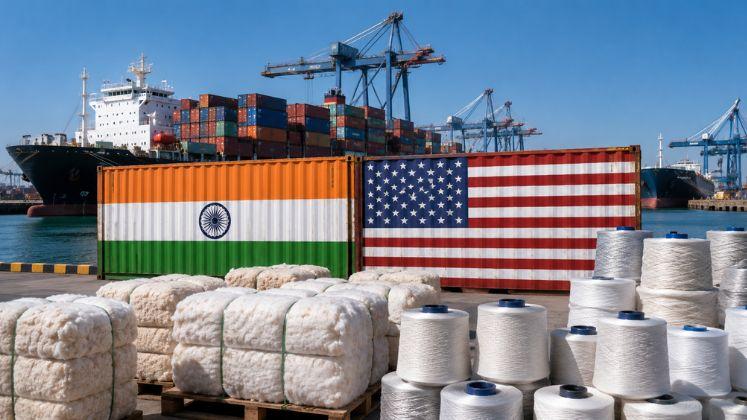
India has strongly refuted allegations of overcapacity in its textile sector, with senior trade officials arguing that domestic demand continues to outstrip supply in key segments and that the country remains far from self-sufficient in several critical raw materials.
Speaking on the issue, Amitabh Kumar, Director General of Trade Remedies (DGTR), said India’s per capita textile consumption remains significantly lower than that of developed economies despite climatic conditions that result in higher wear and tear of garments. He maintained that claims of overcapacity in the sector do not reflect the realities of domestic consumption and production requirements.
The DGTR highlighted that India is not self-reliant in man-made fibres (MMF) and continues to depend on imported raw materials. It also pointed to the import of 4.7 million bales of cotton during the previous year, following a decline in domestic cotton production in recent years, as evidence that local capacity remains insufficient to fully meet demand.
The remarks come as the United States conducts Section 301 investigations into several countries, including India, examining issues such as forced labour and industrial overcapacity. The investigations could potentially result in additional duties on exports to the US market, affecting the competitiveness of Indian products.
Kumar noted that provisions relating to forced labour do not fall within the framework of the World Trade Organisation (WTO). He further stated that assessments of overcapacity often depend on the perspective of individual countries and argued that such investigations are frequently designed to target specific nations while also serving a range of broader objectives.
Addressing India’s trade defence framework, Kumar stated that the country does not provide export subsidies to its industries. He explained that when Indian exports are subjected to countervailing duty investigations, the government may be required to present evidence or defend its position before the relevant authorities.
According to Kumar, between 40 and 50 trade defence investigations are active at any given time, covering sectors facing competitive pressure from subsidised imports originating from various countries.
He identified anti-dumping, countervailing and safeguard measures as the principal trade defence instruments employed by India to protect domestic industries.
The DGTR explained that anti-dumping duties are imposed when imported goods are sold in the Indian market at unfairly low prices and cause injury to domestic manufacturers. Countervailing duties, meanwhile, are applied to imports benefiting from government subsidies in the exporting country that adversely affect Indian producers. In such cases, the foreign government concerned is also notified.
- Core Fashion & Textile Value Chain
- Circularity, Sustainability & Waste Management
- Sustainability Enablers & Solutions
- Technology, Platforms & Innovation
- Retail, Trade & Market Access
- Knowledge, Institutions & Ecosystem Builders
- Finance, Investment & Support
- Logistics, Infrastructure & Operations
- Media, Communication & Culture
- Others

 English
 Arabic
 French
 Spanish
 Portuguese
 Deutsch
 Turkish
 Dutch
Dutch
 Russian
 Romaian
 Portuguese (Brazil)
 Greek
Greek