


West Asia Conflict Drives Input Cost Surge for Gujarat’s Textile and Chemical Industries
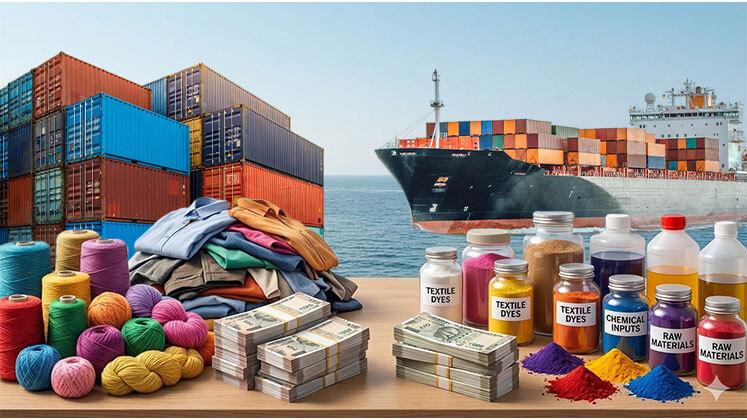
Industrial units in Gujarat’s key textile and chemical clusters are facing rising production costs and supply disruptions as the ongoing Israel-Iran conflict pushes up energy and raw material prices, industry representatives have said.
Manufacturers in Ahmedabad’s chemical clusters reported that gas companies have curtailed supplies to industrial consumers, forcing factories to scale back production. Several units are currently receiving only around 40% of their normal gas requirement, significantly affecting output and tightening the availability of key raw materials.
Industry representatives said the reduced supply has already triggered a sharp increase in prices of basic chemicals and intermediates, with some products becoming 30-40% more expensive compared with prices two weeks ago.
The rise in chemical prices has also affected textile processors, as colour chemicals used in dyeing and finishing have become more expensive. Industry sources said several processing units in Ahmedabad have already revised job-work rates for new orders starting this week.
Textile processors in the Narol cluster are also dealing with higher fuel costs, as many units depend on imported coal and lignite. Fuel typically accounts for about a quarter of production costs for processing houses, making them particularly sensitive to global price fluctuations.
J K Vyas, chief executive officer of Narol Textile Infrastructure and Enviro Management (NTIEM), said demand for textile processing services had remained stable but rising costs had disrupted operations. He observed that demand had strengthened after a reduction in GST ahead of the Diwali season and had remained steady since then, but the conflict had affected the entire supply chain. According to him, processing units have not been able to pass the full burden of higher costs on to buyers.
Gaurang Bhagat, president of the Maskati Cloth Market Mahajan, said textile processors had informed traders about an increase in job-work charges. He stated that processing units had announced an average increase of around 5% in job-work rates from Monday due to rising raw material costs.
Ahmedabad is among India’s largest cotton textile processing centres. The Narol cluster alone houses around 125 processing units that collectively process about 2.8 billion metres of fabric annually and provide direct employment to nearly 150,000 workers.
The impact of global tensions is also being felt in Surat, one of the country’s largest hubs for man-made fibre textiles. Industry representatives said the sharp rise in crude oil prices has led to rapid increases in yarn costs and disrupted immediate supply in the market, making it difficult for weavers to maintain production of grey cloth.
Mayur Golwala, secretary of the Sachin Industrial Society, said the sharp increase in manufacturing costs could force weavers to temporarily reduce production. He suggested that if operating under current conditions became financially unviable, weavers might need to halt production for two or three days a week. He also urged the government to ensure the availability of affordable, high-quality imported yarn to keep the weaving sector operational and protect employment.
Golwala said crude oil prices, a key input for synthetic yarn production, had risen from about US $ 73 on 4th March to nearly US $ 100, causing significant disruption in Surat’s man-made fibre textile sector, which consumes large quantities of polyester, viscose and nylon yarn each day.
According to him, spinners have increased polyester yarn prices by around Rs. 20 (US $ 0.22) per kilogram over the past week to ten days, while nylon mother yarn and filament yarn prices have risen by Rs. 25-Rs. 30 (US $ 0.27-US $ 0.33) per kilogram. He also noted that some nylon spinners had recently informed the market of a temporary halt in yarn sales.
Industry representatives said some spinners have begun linking yarn prices directly to international crude oil rates and are offering supplies only on immediate payment terms, increasing the working capital burden for weavers who typically operate on a 30-day credit cycle with grey cloth merchants.
Golwala further alleged that certain producers may be restricting yarn supply to push up prices and said preparations were under way to lodge a formal complaint with the Competition Commission of India seeking action against alleged cartelisation.
- Core Fashion & Textile Value Chain
- Circularity, Sustainability & Waste Management
- Sustainability Enablers & Solutions
- Technology, Platforms & Innovation
- Retail, Trade & Market Access
- Knowledge, Institutions & Ecosystem Builders
- Finance, Investment & Support
- Logistics, Infrastructure & Operations
- Media, Communication & Culture
- Others
 Portuguese
 English
 Arabic
 French
 Spanish
 Deutsch
 Turkish
 Dutch
Dutch
 Italiano
 Russian
 Romaian
 Portuguese (Brazil)
 Greek
Greek