


Election-Linked Labour Migration Costs Gujarat Textile Sector US $125 Million, Says Industry
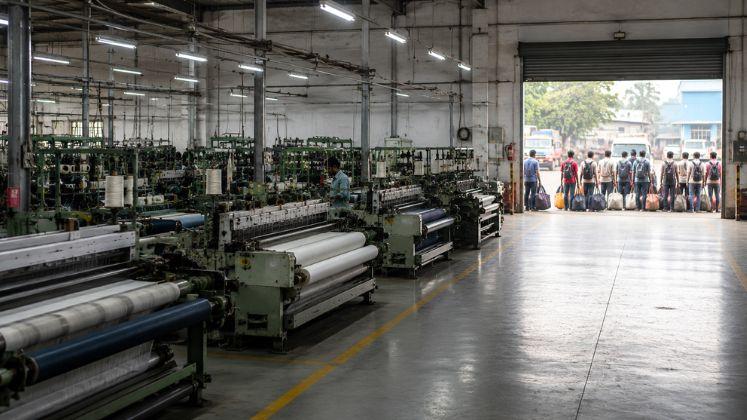
Gujarat’s textile and manufacturing sectors are facing significant production disruptions due to repeated election cycles and the large-scale migration of migrant workers during polling periods, according to industry representatives participating in consultations held by the Joint Parliamentary Committee (JPC) examining the proposed “One Nation, One Election” framework.
The consultations were conducted in Gujarat as part of the parliamentary panel’s broader stakeholder outreach linked to the Constitution (129th Amendment) Bill, 2024, and related legislative proposals aimed at enabling simultaneous elections across the country.
Industry leaders stated that Gujarat’s textile industry, particularly the Surat textile cluster, is among the worst affected sectors because of its heavy dependence on migrant labour from northern and eastern Indian states.
Pathik Patwari, Chairman of the Indian Chamber of Commerce (Gujarat chapter) and former president of the Gujarat Chamber of Commerce and Industry (GCCI), stated that Gujarat’s manufacturing economy is structurally dependent on migrant workers, with industry estimates placing the number of migrant labourers in the state at between 40 lakh and 45 lakh.
He stated that these workers primarily come from Uttar Pradesh, Bihar, Odisha, Jharkhand, Chhattisgarh, Madhya Pradesh and West Bengal.
According to Patwari, election-related migration creates recurring production disruptions across industrial clusters, particularly because workers often leave their workplaces nearly 15 days before polling and return around 15 days afterwards. He further estimated that industrial output declines by around 15%-20% during such periods because of labour shortages and operational disruptions.
Patwari estimated that repeated election cycles result in an annual economic loss of approximately Rs.12,000 crore (US $1.25 billion) to Rs.15,000 crore (US $1.57 billion) for Gujarat’s industries due to cumulative productivity decline and prolonged worker absenteeism.
The textile sector in Surat was identified as the most severely affected segment during the consultations. A representative from the Southern Gujarat Chamber of Commerce and Industry stated that Surat’s textile industry records monthly production of nearly Rs.8,000 crore (US $838 million).
The representative estimated that election-linked migration leads to an average production impact of around 15%, translating into monthly output losses of approximately Rs.1,200 crore (US $125 million) during affected periods.
He further stated that Surat’s textile ecosystem employs nearly 15 lakh migrant workers, largely from Uttar Pradesh, Bihar, Jharkhand, Odisha and West Bengal, making the sector highly vulnerable to workforce disruptions during election periods.
Surat’s textile ecosystem comprises around 22,000 weaving units, 400 processing houses, nearly 20 spinning units, around 20 yarn units, approximately 250 knitting units and between 2,000 and 2,500 garment manufacturing units. Weaving and processing operations were identified as the most labour-intensive segments within the textile value chain.
Industry representatives also highlighted that repeated election cycles trigger administrative slowdowns because of the enforcement of the Model Code of Conduct, during which approvals linked to subsidies, land allocation, industrial clearances and policy decisions are often delayed.
They stated that such delays increase financing costs, postpone investments and affect industrial expansion timelines across manufacturing sectors.
- Core Fashion & Textile Value Chain
- Circularity, Sustainability & Waste Management
- Sustainability Enablers & Solutions
- Technology, Platforms & Innovation
- Retail, Trade & Market Access
- Knowledge, Institutions & Ecosystem Builders
- Finance, Investment & Support
- Logistics, Infrastructure & Operations
- Media, Communication & Culture
- Others

 English
 Arabic
 Spanish
 Portuguese
 Deutsch
 Turkish
 Dutch
Dutch
 Italiano
 Russian
 Romaian
 Portuguese (Brazil)
 Greek
Greek