


India’s Textile Sector Has Major Growth Opportunity Despite Global Challenges: Nirmala Sitharaman
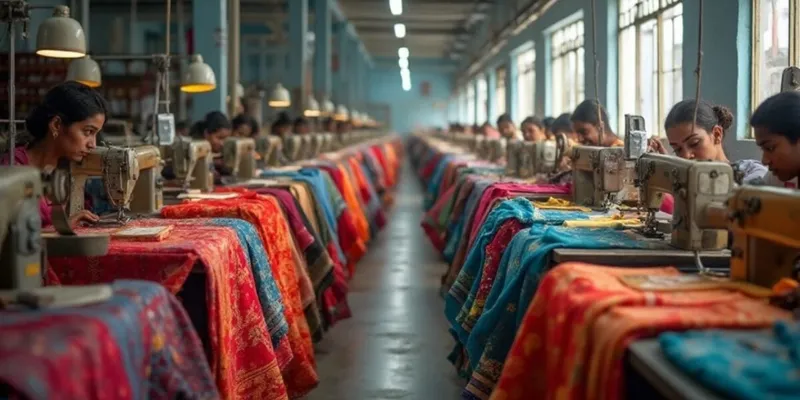
Climate change, geopolitical tensions and technology shifts may reshape textile trade, says Finance Minister at TEXPROCIL Export Awards in Mumbai
Finance Minister Nirmala Sitharaman said India’s textile industry must prepare for a changing global trade environment shaped by climate change, geopolitical tensions and rapid technological developments. Speaking at the TEXPROCIL Export Awards function in Mumbai, Sitharaman said India also has an opportunity to strengthen its role in the global textile supply chain as sourcing patterns continue to shift.
She said the coming decade would bring increasing uncertainty for the sector, with climate-related disruptions, supply chain volatility and evolving manufacturing technologies expected to impact global trade and labour markets.
Speaking at the TEXPROCIL Export Awards function in Mumbai, Finance Minister Nirmala Sitharaman said India’s textile industry must prepare for an increasingly uncertain global trade environment marked by rising protectionism, sustainability-linked trade barriers and stronger competition from manufacturing economies.
“The decade ahead will not be easy. Climate change will affect cotton yields. Geopolitical disruptions will create supply chain volatility. Technology will continue to disrupt labour markets,” she said.
At the same time, Sitharaman said global supply chains were opening new opportunities for India as countries diversify sourcing away from single-country dependencies.
“Crises, as Prime Minister Modi often reminds us, are also opportunities. India’s moment in the global textile order is now,” Sitharaman said.
India’s textile exports, including handicrafts, stood at $33.5 billion in 2025-26, while the sector contributes around 2.3% to the country’s GDP and remains one of the largest employment generators in the country.
Outlining the government’s long-term vision under the Viksit Bharat 2047 roadmap, Sitharaman said India aims to achieve $100 billion in textile exports and $250 billion in textile production by 2030. She added that India’s fibre production, currently estimated at around 15 million metric tonnes, would need to rise significantly to support future growth.
The finance minister cautioned exporters that global trade rules were changing rapidly due to geopolitical fragmentation and rising protectionism.
“Many countries are imposing non-tariff barriers, including stringent sustainability requirements, supply chain due diligence laws and carbon border adjustment mechanisms,” she said.
Sitharaman also said sustainability was no longer optional for exporters as global retailers such as H&M, Zara and Marks & Spencer increasingly demand traceability, organic or recycled fibres, reduced water consumption and lower carbon footprints in sourcing practices.
“Our exporters who adapt early to these requirements will thrive,” she said.
Highlighting the growing role of technology, Sitharaman said artificial intelligence, robotic sewing, digital printing and smart manufacturing were steadily reducing traditional labour-cost advantages in the textile industry.
“We must invest in technology not just to compete on cost but to compete on capability,” she said.
The minister also called for greater investment in design, branding and technical textiles, while urging the industry to position India’s GI-tagged textiles such as Banarasi, Pochampally and Chanderi as premium global sustainable products rather than “charity purchases”.
- Core Fashion & Textile Value Chain
- Circularity, Sustainability & Waste Management
- Sustainability Enablers & Solutions
- Technology, Platforms & Innovation
- Retail, Trade & Market Access
- Knowledge, Institutions & Ecosystem Builders
- Finance, Investment & Support
- Logistics, Infrastructure & Operations
- Media, Communication & Culture
- Others

 English
 Arabic
 French
 Spanish
 Portuguese
 Deutsch
 Turkish
 Dutch
Dutch
 Italiano
 Russian
 Romaian
 Greek
Greek