


India–EU FTA Draft Sets Clearer Origin Rules to Boost Textile Export Competitiveness
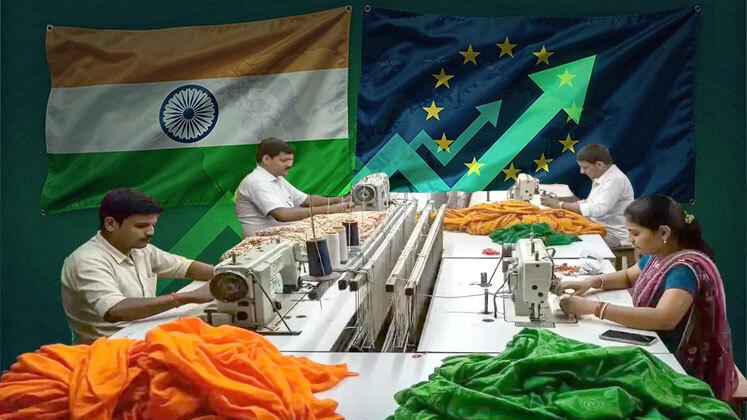
Draft provisions under the proposed India–European Union free trade agreement (FTA) seek to provide greater clarity and predictability for Indian textile exporters in qualifying for preferential tariff treatment, a development that could strengthen the competitiveness of the labour-intensive sector and widen its access to the European market.
Under Chapter 3 of the draft FTA text, which addresses rules of origin, a product will qualify as originating if it is either wholly obtained in a country or satisfies the product-specific requirements outlined in Annex II. For textiles, Annex II stipulates that, in general, up to 10% by weight of basic textile materials may be non-originating, meaning they can be sourced from outside the country. In certain specified cases, this tolerance threshold may increase to 20% or 30%, depending on the product category. Where these limits are exceeded, exporters must comply with defined transformation or value-addition criteria to secure preferential tariffs.
For goods classified under Chapters 50 to 63 of the Harmonised System, the draft agreement establishes sector-specific tolerance provisions rather than applying a single uniform rule across all goods. The text, released by the Union commerce ministry on Friday, allows limited use of non-originating textile materials within prescribed percentage limits by weight. This is considered significant for the textile industry, where manufacturers commonly rely on a mix of domestic and imported fibres or speciality yarns.
India and the EU announced in January the successful conclusion of negotiations for what they described as a historic trade pact, aimed at opening markets to each other amid a volatile global trade environment. From India’s perspective, the agreement is expected to deliver unprecedented market access, with more than 99% of Indian exports by trade value set to receive preferential or duty-free entry into the EU market.
The draft rules provide measured flexibility while maintaining clear value-addition requirements within India. At the same time, the text explicitly excludes certain minimal processes — such as packaging, ironing, labelling or minor assembly — from conferring originating status.
The agreement also introduces bilateral cumulation of origin. Under this provision, inputs originating in the EU may be treated as originating when further processed in India. For exporters sourcing fabrics or accessories from Europe, this could simplify compliance with origin requirements and facilitate access to tariff benefits.
In addition, the draft text specifies a distinct de minimis tolerance for textile products, rather than relying solely on the general 10% value-based rule that applies to most other sectors. This acknowledges the complex and globally integrated nature of textile supply chains and provides limited operational flexibility in the use of non-originating materials.
Clear record-keeping and verification procedures have also been outlined. While exporters will be required to maintain robust documentation, the defined compliance framework is expected to reduce the scope for arbitrary interpretation of origin claims.
India’s textile and apparel exports to Europe rose to US $ 2.34 billion in FY ’25 from US $ 2.11 billion in FY ’24, marking a year-on-year increase of nearly 11%.
- Core Fashion & Textile Value Chain
- Circularity, Sustainability & Waste Management
- Sustainability Enablers & Solutions
- Technology, Platforms & Innovation
- Retail, Trade & Market Access
- Knowledge, Institutions & Ecosystem Builders
- Finance, Investment & Support
- Logistics, Infrastructure & Operations
- Media, Communication & Culture
- Others

 English
 Arabic
 French
 Spanish
 Portuguese
 Deutsch
 Turkish
 Dutch
Dutch
 Italiano
 Russian
 Romaian
 Greek
Greek