


Government Plans Identification of 100 Products for Domestic Manufacturing Expansion
DPIIT outlines local manufacturing strategy, quality initiatives, and sector-focused production roadmap
The government plans to identify 100 products that are currently not manufactured in India for focused domestic production initiatives. The move is aimed at strengthening local manufacturing capabilities, addressing technology gaps, and creating export market opportunities.
Speaking in New Delhi on May 11, Amardeep Singh Bhatia, Secretary, Department for Promotion of Industry and Internal Trade (DPIIT), said the initiative is intended to support manufacturing growth across sectors where domestic production capabilities remain limited.
“We have identified a set of products. Some very interesting products have come up in the auto sector and motorcycles. We came to know that there are a lot of things that are not getting manufactured in India. We have the capability, perhaps some gaps in technology exist,” Bhatia said at the CII event.
According to Bhatia, the government is also focusing on promoting manufacturing of intermediate goods. He said attention should be given to the “missing middle,” particularly in supporting smaller MSMEs to scale operations and bridge gaps between raw material and finished goods production.
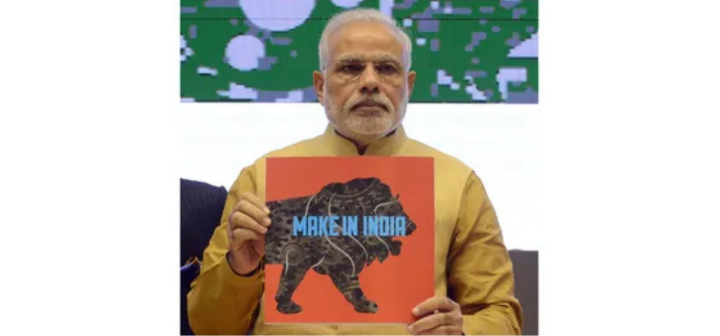
“For Indian manufactured goods, the government would soon be launching the Made-in-India label scheme after running a successful pilot with the steel sector. The Made-in-India brand will indicate what has been the value addition in India on a product and assure quality. We will have discussions with industries as to whatever sectors it can be rolled out for, the framework is work is ready,” Bhatia said.
The scheme was announced in August 2025 to strengthen the reputation of Indian products. According to the report, the initiative will not require manufacturers or companies to undergo additional quality approvals beyond existing certification systems of the Bureau of Indian Standards (BIS) or other certifying bodies.
“We have started with National Quality Conclaves from Quality Council of India (QCI). In series one we had four sectors chosen – textile, leather, footwear and pharma where after extensive interaction with the industry for 2-3 months we have come up with a roadmap for improving quality. Four more sectors will be chosen for rollout soon,” Bhatia said.
He further stated that under 14 PLI schemes, investments worth ₹1.88 lakh crore have already been made, while an additional ₹1.97 lakh crore has been planned.
“The government has been looking at the demand side through GST reforms in domestic demand sector and also in creating new demand through the various Free Trade Agreements (FTA) which have been aggressively pursued and signed. On the operations side we are also working within industry by bringing reforms to ensure that costs come down,” the secretary said.
- Core Fashion & Textile Value Chain
- Circularity, Sustainability & Waste Management
- Sustainability Enablers & Solutions
- Technology, Platforms & Innovation
- Retail, Trade & Market Access
- Knowledge, Institutions & Ecosystem Builders
- Finance, Investment & Support
- Logistics, Infrastructure & Operations
- Media, Communication & Culture
- Others

 Arabic
 French
 Spanish
 Portuguese
 Deutsch
 Turkish
 Dutch
Dutch
 Italiano
 Russian
 Romaian
 Portuguese (Brazil)
 Greek
Greek