


Flipkart eyes ₹100 crore sales from Santipuri sarees this year
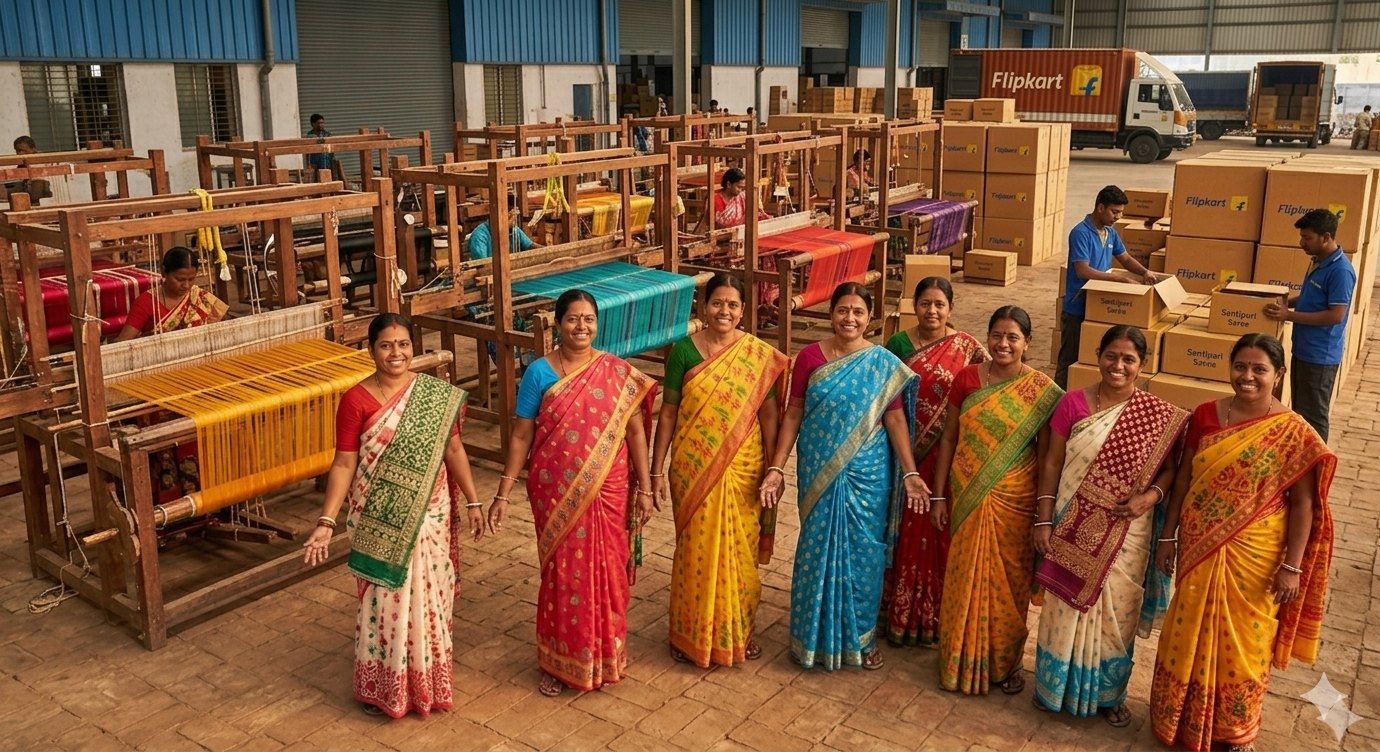
The number of sellers is projected to double by 2027, reflecting growing demand and expanding market access for heritage products
Flipkart, which has adopted an on-ground initiative for providing institutional support to weavers and sellers of Santipuri heritage sarees, expects total sales of these famed Tant, handloom and Jamdani sarees through its online marketplace to cross Rs 100 crore this year.
Santipur, a historical Bengal town, is a centuries-old hub for exquisite handloom sarees, with the rich artistry of intricately handwoven and featherlight sarees passed down through generations of weavers.
The region represents a strong growth opportunity, with saree weavers and sellers expected to double their overall sales on Flipkart by 2027. In the same period, the e-commerce giant expects the number of weavers and sellers on its platform to grow to over 1000 from the current 500.
The e-commerce company has adopted its cluster-based initiative at Santipur in West Bengal’s Nadia district — ensuring greater digital onboarding of weavers and sellers, bolstering their market access across the nation and with consumer demand, and widening their income opportunities.
The company began engaging with the Santipur cluster in 2025. Currently, around 30 per cent of the people actively selling Santipuri sarees on its platform are weavers.
Sales momentum and growth targets
“Last year, total cluster sales, including weavers and sellers, reached around Rs 70 crore on the platform. Direct weavers made sales of around Rs 25 crore, which was a 50 per cent year-on-year growth compared to previous year. Our goal is to cross Rs 100 crore this year,” Kapil Thirani, Vice President, Marketplace and Shopsy, Flipkart, told businessline.
Clusters driving traditional craft economies
Certain regions and towns across India have a strong national reputation for specialised crafts such as Tant, handloom and Jamdani sarees in Shantipur; Banarasi sarees in Mau; brass handicrafts in Moradabad; ceramics in Khurja, Uttar Pradesh; and textiles in Tirupur, Tamil Nadu, making them key focus areas for cluster-based initiatives.
“In West Bengal, we have identified that there is a lot of manufacturing happening but many of these people are non-digitized. We have visited a lot of manufacturing houses in Santipur. Here sarees are at the price point that e-commerce sells, and at the range that consumers on e-commerce are looking for. That is where we went ahead and built a team,” Thirani said, adding the team went there and scouted for talented weavers and sellers.
Bridging digital gaps for weavers
A problem the company faced initially was that weavers were not digitally savvy. “A lot of them will do as instructed, but they are not figuring it out themselves. How do I start cataloguing? Cataloguing is the first problem. So, we introduced AI-driven cataloguing. It has become very simple now,” Thirani added.
Expansion across other craft clusters
Notably, more than 500 active sellers from the Mau cluster, known for its art silk sarees, are selling their products on Flipkart. Building on growing demand and seller participation, this cluster is targeting a fivefold year-on-year growth in sales this year.
Currently, around 1500 sellers from the Moradabad cluster are actively selling on the marketplace. This cluster is experiencing strong growth momentum, aiming to double sales year-on-year. Uttar Pradesh’s Moradabad is a key manufacturing hub for metal home décor and housewares, including vases, planters, metal wall clocks, showpieces, coffee tables, and other metal items.
Flipkart said it is transforming the way weavers and artisans in India connect with markets, unlocking new livelihood opportunities beyond traditional local boundaries. Through continued investments in logistics, supply chain, and on-ground support for sellers, the platform is helping sellers scale their businesses and build sustainable, long-term income opportunities. This is also driving increased demand for heritage products from manufacturing clusters in Tier 2 and Tier 3 regions.
- Core Fashion & Textile Value Chain
- Circularity, Sustainability & Waste Management
- Sustainability Enablers & Solutions
- Technology, Platforms & Innovation
- Retail, Trade & Market Access
- Knowledge, Institutions & Ecosystem Builders
- Finance, Investment & Support
- Logistics, Infrastructure & Operations
- Media, Communication & Culture
- Others

 English
 Arabic
 French
 Spanish
 Portuguese
 Deutsch
 Turkish
 Dutch
Dutch
 Italiano
 Russian
 Romaian
 Greek
Greek