


Centre Assesses Gas Supply Risks to Textile Clusters Amid Ongoing Shortages
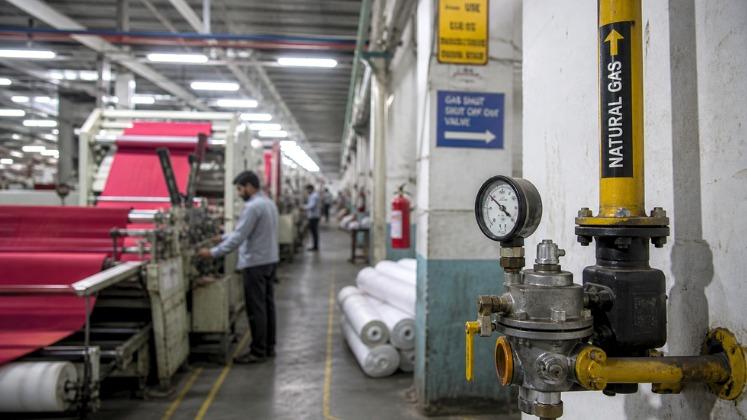
India’s Ministry of Textiles has initiated a nationwide assessment of natural gas availability across textile and handicraft clusters to identify potential supply shortfalls, amid ongoing disruptions in global energy markets.
According to officials familiar with the matter, the move follows assurances from GAIL (India) Limited that it is capable of sourcing additional gas from the spot market to mitigate any supply disruptions affecting the sector. However, officials indicated that such procurement would likely come at a higher cost, which would be passed on to industrial units.
Sources stated that GAIL is currently meeting at least 80% of the natural gas requirements of these clusters, which are classified as a priority sector. They added that in the event of further supply shocks, the company is prepared to procure gas from the spot market to bridge the gap, albeit at elevated prices.
India has more than 500 textile clusters and 700 handicraft clusters, many of which rely heavily on natural gas for operations such as high-temperature dyeing and powering furnaces and machinery.
The supply constraints have been exacerbated by disruptions in global energy trade routes, linked primarily to geopolitical tensions in West Asia and the prolonged blockade of the Strait of Hormuz. Government data indicates that India’s total natural gas consumption stands at approximately 189 million metric standard cubic metres per day (MMSCMD), of which 97.5 MMSCMD is produced domestically, with the remainder met through imports.
Officials noted that around 47.4 MMSCMD, or nearly 25% of India’s gas supply, has been impacted due to force majeure declarations by major Gulf-based producers, effectively suspending long-term supply contracts amid the ongoing conflict.
Key textile hubs, including Surat and Sanganer, have reported acute shortages of natural gas and liquefied petroleum gas (LPG), leading to partial or complete shutdowns of units. The disruptions have also resulted in labour displacement, with workers returning to their hometowns.
In response to the situation, the government issued a Natural Gas Control Order on 9 March 2026 under the Essential Commodities Act, aimed at regulating supply and safeguarding priority sectors such as textiles and handicrafts.
- Core Fashion & Textile Value Chain
- Circularity, Sustainability & Waste Management
- Sustainability Enablers & Solutions
- Technology, Platforms & Innovation
- Retail, Trade & Market Access
- Knowledge, Institutions & Ecosystem Builders
- Finance, Investment & Support
- Logistics, Infrastructure & Operations
- Media, Communication & Culture
- Others

 Arabic
 French
 Spanish
 Portuguese
 Deutsch
 Turkish
 Dutch
Dutch
 Italiano
 Russian
 Romaian
 Portuguese (Brazil)
 Greek
Greek