


Textiles Ministry Sets Up Monitoring Cell to Ensure Supply Stability Amid West Asia Crisis
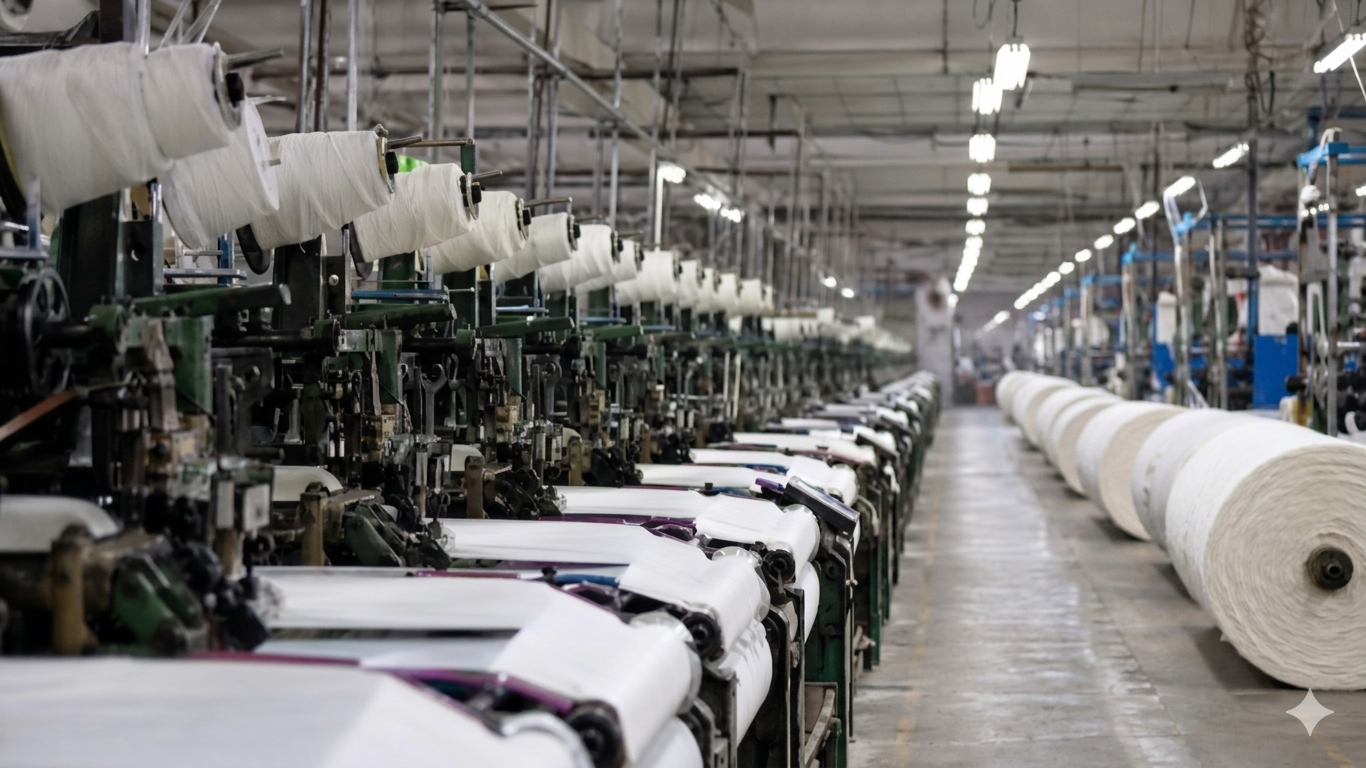
The Textiles Ministry has set up a monitoring cell to coordinate with Export Promotion Councils, industry bodies, government agencies and other stakeholders, particularly in the man-made fibre sector, in view of recent developments in West Asia.
The development comes as India’s textile industry faces mounting pressure from the West Asia conflict, with crude-linked inputs driving costs sharply higher and disrupting supply chains.
In major clusters like Surat, which houses over 400 textile processing units, shipping costs have surged by up to 400%, while yarn and raw material prices have risen 15–50%,with production going down by around 40% in this textile cluster. Surat also saw workers leaving en masse due to the high costs and low availability of LPG cylinders preventing them from cooking their food.
According to the Southern India Mills Association (SIMA), the price of polyester fibre increased by Rs 12 (US$0.13) per kilogram during the US-Iran crisis. Polyester 1.2 denier fibre has been priced at Rs. 114.25 (US$1.24) per kilogram.
Similarly, the Tiruppur Exporters’ Association (TEA) noted that the current geopolitical tension had increased costs in logistics because shipments had to go around the Cape of Good Hope adding 10-15 days to delivery times, coal prices increased by up to 80%, and chemicals and MMF by up to 20%.
Besides this, a critical concern is labour welfare, as 400,000 workers are housed in Tirupur hostels, which have a heavy dependence on commercial LPG.
The monitoring cell has been holding regular consultations with EPCs and stakeholders to address issues such as shipping disruptions, logistics planning, and cost optimisation, while also sharing advisories from the Directorate General of Shipping (DG Shipping) and exploring alternative trade routes, including via Jeddah.
“The ministry is also coordinating with the Petroleum Ministry and GAIL to ensure around 80% supply continuity, with focus on ensuring export stability, supply chain resilience, and sectoral support during the ongoing situation. We are also working with the Department of Revenue on customs duty rationalisation, including reductions on key textile inputs, and have proposed further duty relief on essential raw materials,” said Bipin Menon, Trade Advisor to the Ministry of Textiles.
Officials from the Ministry of Petroleum and Natural Gas noted that the government has ensured 100% supply for domestic LPG, PNG, and CNG consumers despite disruptions in crude and gas imports, with steps being taken to minimise the impact amid the ongoing West Asia crisis.
The Ministry of Textiles is also considering withdrawing customs duty on raw cotton imports.
The textile industry has been urging the government to remove the 11% customs duty on raw cotton imports to ease cost pressures on domestic companies and protect the sector and also has sought the removal of the 2.5% customs duty on rayon-grade wood pulp, an input for the viscose chain.
Currently, raw cotton imports attract a 5% basic customs duty. The government had earlier provided duty relief on cotton imports between 19th August and 30th September 2025, a relief later extended until 31st December 2025.
- Core Fashion & Textile Value Chain
- Circularity, Sustainability & Waste Management
- Sustainability Enablers & Solutions
- Technology, Platforms & Innovation
- Retail, Trade & Market Access
- Knowledge, Institutions & Ecosystem Builders
- Finance, Investment & Support
- Logistics, Infrastructure & Operations
- Media, Communication & Culture
- Others
 Spanish
 English
 Arabic
 French
 Portuguese
 Deutsch
 Turkish
 Dutch
Dutch
 Italiano
 Russian
 Romaian
 Portuguese (Brazil)
 Greek
Greek