


BioTex 2026: India’s Textile Industry Gets Serious About Circular Business
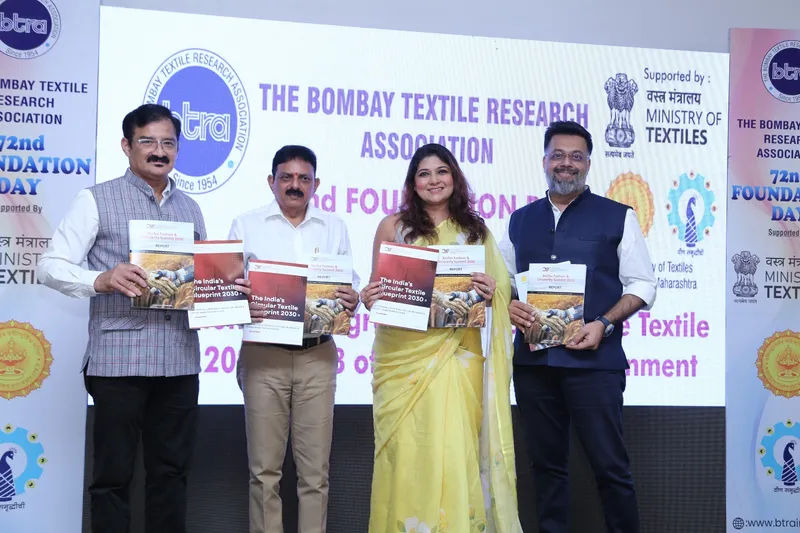
India’s textile sector is finally moving past talk and into action on sustainability. The BioTex Fashion & Circularity Summit 2026, held on 13–14 March in New Delhi, brought together government officials, manufacturers, brands, and investors to map out how the country will hit its USD 100 billion export target by 2030—but only if the industry goes circular.
The core problem is simple: India currently exports USD 37.8 billion in textiles annually. Getting to USD 100 billion in five years requires 20% growth every year. That won’t happen if India stays in the cheap-manufacturing game. Global buyers—particularly from the EU and US—are now demanding verifiable circularity, lower carbon footprints, and full supply chain traceability. Companies that can’t prove their environmental claims will be shut out of major markets.
What’s Actually Broken
The summit exposed three major bottlenecks holding India back. First, supply chain fragmentation. While large garment makers can meet global standards, the smaller spinners, dyers, and waste processors—Tier 2 and Tier 3—lack basic digital infrastructure. They can’t track materials, can’t report emissions, can’t integrate Digital Product Passports (the EU is making these mandatory). A dyeing unit in Tirupur operates the same way it did 20 years ago.
Second, the scaling problem. Labs across India have cracked the chemistry of turning agricultural waste into usable fibre. Startups like AltMat can prove their materials work. But moving from a 5-tonne pilot to 100-tonne commercial production? That’s where everything breaks down. No mill will dedicate expensive machinery to test unproven materials. Traditional banks won’t finance it. So innovations sit in the pilot phase indefinitely.
Third, the money gap. Tier 2 and Tier 3 mills can’t afford the capital investment needed for Zero Liquid Discharge systems, renewable energy, advanced testing labs, or digital traceability platforms. Brands demand these upgrades but won’t pay for them. MSMEs are stuck.
The Money Plan
To fix this, IFBEC (International Fashion Business Exchange Council) and the National Mission Committee are pushing for a dedicated ₹500 crore Circular Textile Transition Fund. This isn’t a grant to businesses—it’s a “first-loss guarantee” that lets banks lend to MSMEs at lower rates. The idea: government absorbs the initial risk so private capital flows in. For every rupee the government puts in, the summit calculations suggest ₹20 of private investment follows. That could unlock ₹10,000+ crores by 2030.
The fund would be split three ways: ₹200-300 crore for scaling bio-materials past the 100-tonne mark; ₹150 crore for pre-competitive infrastructure hubs where startups can test materials without destroying a mill’s production schedule; and ₹300-500 crore for system-wide decarbonization—renewable energy, waste recycling lines, that sort of thing.
Agricultural Waste: India’s Hidden Asset
India generates 500 million tonnes of agricultural residue annually. About 100 million tonnes gets burned in open fields, creating catastrophic winter smog. This is a national crisis and a massive business opportunity.
Beetle Regen Solutions, a company that was prominently featured at the summit, has already built a working model. They convert crop waste into biochar, which gets worked back into soil. On cotton T-shirts, this sequesters about 2 kg of CO2 per garment. They’re working with 71,000 farmers across 106,866 hectares, producing 366,000 bales of regenerative certified cotton. Farmer incomes went up 18% through this model.
If just 10% of India’s agricultural waste flows into the textile supply chain by 2030, that’s 50 million tonnes diverted from field burning. It solves the air pollution crisis. It replaces petroleum-based synthetic fibres. It creates rural jobs.
Traceability is the New Requirement
The EU’s new rules on Digital Product Passports aren’t optional anymore. Every garment needs an immutable record: where the cotton came from, how it was processed, which chemicals were used, and how much water was consumed. Brands that can’t prove this won’t get shelf space in Europe.
Green Story, a company providing traceability software, showed the summit that this is actually doable at scale. They’ve analysed 300+ components to build compliant DPPs for 200 styles. But most Indian MSMEs don’t have the digital infrastructure. They don’t know how to collect this data. They don’t have the systems to report it.
The summit recommended tiered standards: M1 is the baseline (basic compliance), M4 is global export-ready. MSMEs start at M1 and graduate upward. This takes the pressure off small suppliers while moving the entire ecosystem forward.
Who Showed Up and What They Said
Kapil Agrawal from Aditya Birla Group talked about technical textiles—the high-value stuff like fireproof fabrics, medical textiles, and industrial applications. The global technical textiles market is USD 274 billion by 2027. India’s penetration? Only 10-12%. That’s where the real growth is.
Prashant Agarwal from Wazir Advisors was blunt: “Something which is not creating profits is not sustainable. Nobody is going to fund it. Sustainability has to be made profitable.” This wasn’t abstract philosophy. He was saying the transition only works if it makes business sense.
Shikha Shah from AltMat spoke about the infrastructure gap. “If you’re launching when it’s too perfect, you’re late. The flywheel hasn’t started, so you need pre-competitive fibre infrastructure.” In other words, brands need access to samples of new materials immediately, not after months of testing.
Subir Mukherjee from Bhaskar Denim said scaling circularity requires “schooling every day”—meaning continuous production testing, not one-off trials.
Ranjan Chaudhary from Sutlej Industries nailed the real problem: “The technology exists—waste to fibre, fibre to yarn, yarn to fabric. What we need now is continuity. It’s a chicken-and-egg problem: we need orders to improve, and the market needs assurance to place orders.”
On the brand side, Aishwarya Sharma from Puma said traceability is becoming the new luxury signal. Gen-Z doesn’t buy stories anymore. They want proof. Digital transparency is what builds loyalty now.
Kavita Sachwani from the UN Environment Programme Finance Initiative emphasized that circularity has to be bankable. “The textile sector presents a strong case for circular finance,” she said, “but financial institutions still face barriers—perceived risk, weak project pipelines, and limited standardisation of metrics.” The summit is trying to fix this by creating standardised metrics that banks can actually use.
Siddharth Lulla from Intellecap added that finance must work as a continuum across early-stage, growth, and scale phases. Jayanth Kashyap from Good Fashion Fund noted that the real gap isn't money—it's "investment readiness" in MSMEs that can meet the reporting standards global green funds demand.
What the Government Needs to Do
Additional Secretary Rohit Kansal from the Ministry of Textiles laid out the government’s role. The state needs to: formally recognise the National Mission Committee as an official advisory body; create the ₹500 crore transition fund; integrate circularity standards into PM MITRA and PLI schemes; expand RODTEP export incentives for verified sustainable processes; and build shared green infrastructure parks where MSMEs can access expensive equipment without individual CAPEX.
He also pushed for fast-tracking certifications. Right now, MSMEs navigate a maze of expensive, overlapping global sustainability standards. India should create its own tiered system that leads toward global standards instead of forcing everyone to jump straight to global compliance.
The Job Numbers
The summit projected that scaling circularity could create 5-7 million new jobs by 2030—mostly in rural agro-waste processing, textile recycling, and digital traceability roles. A significant chunk would go to women and rural communities. Waste-sorters, currently informal and unrecognised, would be professionalised and integrated into formal supply chains with social security and digital identity.
Real Impact Models
Conserve India has been running textile waste-preneurship programs—converting garment waste into handspun yarns that feed into luxury slow-fashion collections. Green Story has built Digital Product Passports for over 200 styles across multiple brands. These aren’t hypotheticals anymore.
The Bottom Line
India’s textile industry has spent decades competing on cost and volume. That game is ending. EU regulations, brand mandates, and consumer demand are shifting the playing field to verification, traceability, and genuine environmental impact. The summit made clear: the technology exists, the market demand exists, but the infrastructure and financing don’t.
The industry is now asking: Will the government actually fund this transition? Will brands commit to purchasing agreements that make new materials bankable? Will MSMEs actually adopt these systems?
The BioTex Summit 2026 provided the blueprint. The next 12 months will show whether India’s textile sector can execute on it.
- Core Fashion & Textile Value Chain
- Circularity, Sustainability & Waste Management
- Sustainability Enablers & Solutions
- Technology, Platforms & Innovation
- Retail, Trade & Market Access
- Knowledge, Institutions & Ecosystem Builders
- Finance, Investment & Support
- Logistics, Infrastructure & Operations
- Media, Communication & Culture
- Others

 English
 Arabic
 French
 Spanish
 Portuguese
 Deutsch
 Turkish
 Dutch
Dutch
 Italiano
 Russian
 Romaian
 Portuguese (Brazil)