


Celebrating National Textiles Day: Why ‘Make in India’ Must Now Mean ‘Design in India’
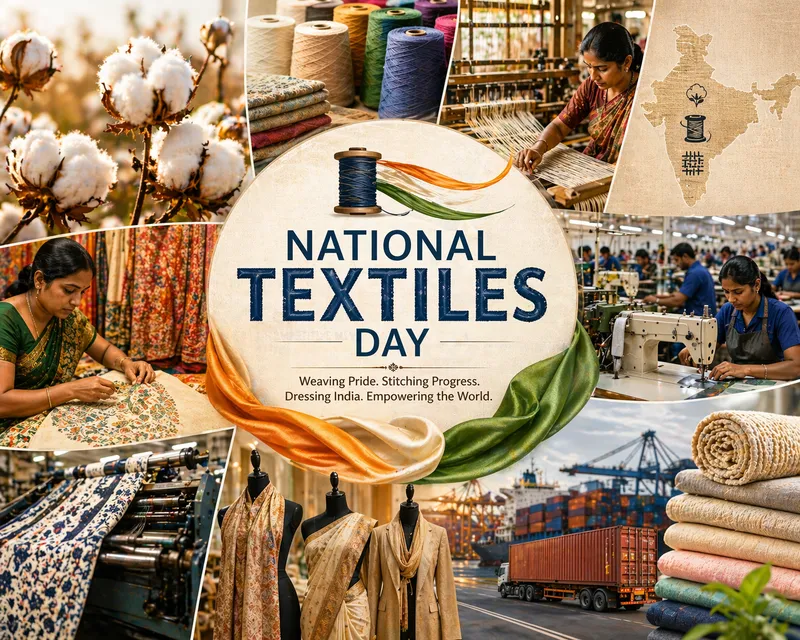
The Indian textile industry has come a long way, evolving from the skilled hands of handloom weavers to the scale and sophistication of modern textile mills. Over the years, it has not only contributed significantly to economic growth but also shaped the country’s cultural identity. This journey reflects a unique blend of heritage and progress.
Today, India stands as the second-largest textile manufacturer in the world, playing a vital role in employment generation, exports, and GDP.[1] However, as global demand patterns evolve and competition intensifies, manufacturing scale alone will not be enough to sustain this leadership. The next phase of growth will depend on how effectively the industry moves up the value chain.
From Manufacturing Hub to a Design Powerhouse
The “Make in India” initiative has laid a strong foundation by positioning the country as a global manufacturing destination. The next step is to complement this with a sharper focus on “Design in India,” enabling higher value creation and stronger global competitiveness.
The textile and apparel market today goes far beyond aesthetics. It is driven by innovation in materials, functionality, performance, and sustainability. Companies must anticipate consumer needs, align with global trends, and create differentiated products that stand out in an increasingly competitive landscape.
Material Innovation with Denim at the Core
The global textile market continues to see a shift towards man-made fibres (MMFs), which account for nearly 70–75% of the market.[2] At the same time, denim remains one of the most relevant and high-impact categories, with consistent demand across geographies and consumer segments.
India has built strong capabilities in denim manufacturing, combining scale with growing innovation and expertise. Increasingly, denim is no longer viewed as a basic fabric but as a dynamic category that blends performance with style. India is the world’s second-largest denim fabric producer, with an installed capacity of 1,734 million metres per annum,[3] catering to both domestic demand and key international markets, strengthening its position in the global value chain.
This shift is evident in the evolution of denim into a highly engineered product. Innovations such as stretch blends, lightweight constructions, blended yarns, and advanced finishing techniques are redefining how denim is designed and consumed. These advancements allow manufacturers to deliver on comfort, durability, and aesthetics simultaneously.
Denim today is also a canvas for differentiation. From washes and textures to finishes and fabric compositions, every element contributes to the final product. This makes design-based development critical in maintaining relevance and competitiveness in global markets.
Sustainability as a Design Imperative
Sustainability is no longer a peripheral consideration. It has become central to the future of the textile industry, driven by environmental concerns, regulatory expectations, and evolving consumer preferences.
In the denim segment, this transformation is particularly significant. Traditionally associated with resource-intensive processes, denim manufacturing is now being reimagined through water-efficient dyeing technologies, reduced chemical usage, and increased adoption of recycled fibres. These advancements are helping position denim as a more responsible and future-ready category.
At a broader level, sustainability requires an all-encompassing approach that integrates resource efficiency, water conservation, and circularity into production processes. Well-planned interventions can play a key role in reducing environmental impact, whether through energy-efficient manufacturing, recyclable fabrics, or longer product lifecycles.
By aligning sustainability with exclusivity, the industry can not only meet global compliance requirements but also create products that resonate with environmentally conscious consumers.
Building a Robust Design Ecosystem
The transition to a design-led industry requires a collaborative ecosystem involving manufacturers, institutions, technology providers, and policymakers. This is particularly relevant for segments like denim, where continuous innovation depends on close collaboration across the value chain.
Investments in education and skill development will be essential to nurture the next generation of textile innovators. At the same time, increased focus on research and development can unlock new possibilities in materials, construction techniques, and product applications.
The adoption of digital tools such as AI-assisted design, data analytics, and virtual prototyping is also accelerating product development cycles. These technologies enable companies to respond faster to changing consumer preferences while improving efficiency and precision.
Equally important is stronger collaboration between manufacturers and brands. Such partnerships can drive innovation and ensure that products are aligned with market demand.
Regional manufacturing hubs and integrated clusters will further play a crucial role in scaling exports, improving operational efficiency, and strengthening India’s position in the global supply chain. This shift can help move India from being a manufacturing destination to becoming a strategic partner in the global textile ecosystem.
The Way Forward
The Indian textile sector is at a pivotal stage, with an ambition to scale to a $350 billion market and achieve $100 billion in exports by 2030. Already contributing over 8.6% to India’s total exports and ranking among the world’s leading textile exporters, the sector is steadily strengthening its global footprint.[4]
Achieving this vision will require a shift from scale-driven growth to value-driven differentiation. This transformation is about rethinking the entire value chain through the lens of innovation, sustainability, and technology, supported by integrated manufacturing clusters, policy incentives, and growing investment in research and development.
The future of the textile industry will belong to those who create differentiated products, not just those who manufacture at scale. As India strengthens its global position, it’s clear that what we make in India should also be designed here.
- Core Fashion & Textile Value Chain
- Circularity, Sustainability & Waste Management
- Sustainability Enablers & Solutions
- Technology, Platforms & Innovation
- Retail, Trade & Market Access
- Knowledge, Institutions & Ecosystem Builders
- Finance, Investment & Support
- Logistics, Infrastructure & Operations
- Media, Communication & Culture
- Others
 Spanish
 English
 Arabic
 French
 Portuguese
 Deutsch
 Turkish
 Dutch
Dutch
 Italiano
 Russian
 Romaian
 Portuguese (Brazil)
 Greek
Greek