


Weaving the Digital Thread: Revolutionising Textile Design and Supply Chains
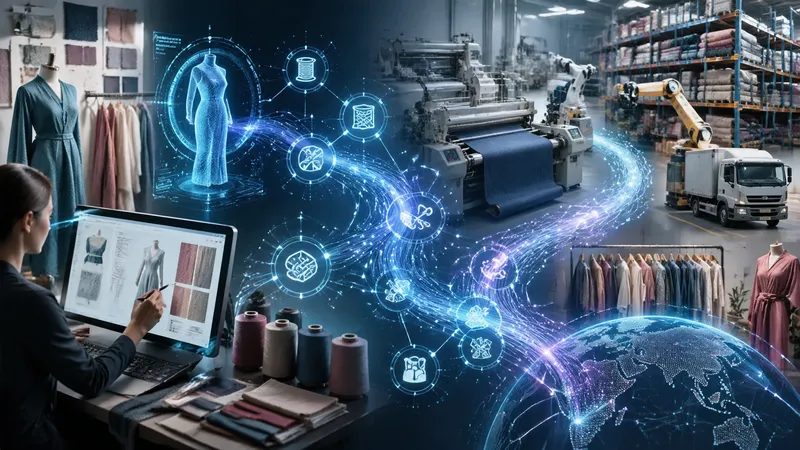
The textile and apparel industry has historically been defined by tactile processes—the feel of a fabric, the drape of a physical sample, and the manual coordination of global logistics. However, as consumer demands accelerate and global disruptions become the norm, the traditional, linear supply chain is undergoing a radical transformation. Today, a "digital thread" is being woven through every stage of the product lifecycle, seamlessly connecting the initial spark of design to the final point of sale. By leveraging advanced digital tools, brands and research institutions are not only optimising their supply chain efficiency but also fundamentally reimagining how products are conceptualised, sourced, and delivered.
AI-Driven Prototyping: Redefining the Creative Process
The traditional design cycle is notoriously resource-intensive, often requiring multiple rounds of physical sampling that cost both time and material. Artificial Intelligence (AI) and 3D digital prototyping are upending this paradigm. Today, designers can use AI-powered generative design tools to rapidly iterate concepts, simulate fabric drape, and test structural integrity in a hyper-realistic virtual environment.
These "digital twins" of garments allow teams to assess fit, colourways, and pattern behaviour before a single piece of fabric is cut. Industry analyses indicate that implementing digital twins can cut sample approval processes from weeks to mere days, significantly mitigating textile waste and driving sustainability right from the drawing board. AI algorithms can also analyse historical sales data and current social media trends, feeding designers with predictive insights that ensure new prototypes are perfectly aligned with market demand. (1)
Bridging the Physical and Digital: Innovations in Sportech and Smart Fabrics
At the Wool Research Association (WRA), our designation as a Center of Excellence (CoE) for Sportech by the Ministry of Textiles places us at the vital intersection of physical material science and digital innovation. When developing specialised technical textiles—such as high-performance cricket pads, advanced protective gear, wool-based athletic shoes, and knotless sports nets—the traditional trial-and-error method is rapidly evolving into a hybrid digital-physical workflow (2).
By integrating digital modelling with WRA’s state-of-the-art mechanical processing and comfort testing facilities, we are able to bridge the gap between virtual concepts and physical reality. For example, in our ongoing R&D projects focused on designing wool-based Novel Denim with multifunctional properties, digital colour matching and virtual fabric simulations happen in tandem with our Textile Colour and Eco Analysis labs. We can digitally anticipate how a fabric will perform regarding thermal insulation, moisture management, and breathability, and then rigorously validate those digital predictions using physical, NABL-accredited parameters. This symbiotic relationship between digital prediction and physical validation accelerates innovation cycles for smart fabrics. (1)
Virtual Collaboration: Erasing Geographical Boundaries
As supply chains stretch across continents, effective communication is often a critical bottleneck. The rise of cloud-based Product Lifecycle Management (PLM) software and virtual collaboration platforms has transformed isolated departments into synchronised global networks.
Designers, manufacturers, and researchers can now collaborate on a single, centralised digital platform in real-time. Annotations on 3D models, instant feedback on tech packs, and automated approval workflows eliminate the delays inherent in email chains. This synchronisation ensures that all stakeholders are working from a single source of truth, reducing errors and accelerating the time-to-market. (3)
Blockchain for Transparency, Traceability, and Sustainability
In an era where consumers and regulators—driven by mandates like the EU's Digital Product Passport (DPP)—are demanding unprecedented accountability, supply chain opacity is no longer acceptable. Blockchain technology has emerged as a definitive solution for establishing an immutable, transparent record of a material's journey. According to the United Nations Economic Commission for Europe (UNECE), blockchain is highly effective at tracking ESG data, raw material harvests, and vendor contracts securely across fragmented networks (3,4).
This digital traceability is crucial when scaling sustainable material innovations. At WRA, we are actively spearheading projects that utilise regional resources, such as developing biodegradable agrotextiles for mulching using Deccani wool fibres, and utilising Indian coarse wool as green building insulation. Integrating blockchain into localised supply chains ensures that every step—from shearing to final processing—is permanently recorded. This empowers stakeholders to authenticate sustainability claims, ensure equitable farmer compensation, and combat counterfeit materials. (6)
Predictive Analytics for Resilient Logistics
The final frontier of the digital supply chain is logistics. Traditional forecasting models, relying heavily on historical data, repeatedly fall short in today's volatile climate. Predictive analytics, powered by machine learning, is transforming supply chain management from a reactive scramble to a proactive strategy.
By synthesising vast datasets—including real-time weather patterns, geopolitical events, port congestion, and shifting consumer sentiment—predictive algorithms can forecast demand spikes and anticipate logistical bottlenecks. Furthermore, as noted by McKinsey & Company, pairing AI with predictive analytics allows supply chains to not only foresee disruptions but also prescribe automated actions—such as rerouting shipments or optimising inventory across regional warehouses (McKinsey, 2026). The result is a lean, agile supply chain that buffers against external shocks. (3,5,6)
- Core Fashion & Textile Value Chain
- Circularity, Sustainability & Waste Management
- Sustainability Enablers & Solutions
- Technology, Platforms & Innovation
- Retail, Trade & Market Access
- Knowledge, Institutions & Ecosystem Builders
- Finance, Investment & Support
- Logistics, Infrastructure & Operations
- Media, Communication & Culture
- Others

 English
 Arabic
 French
 Spanish
 Portuguese
 Turkish
 Dutch
Dutch
 Italiano
 Russian
 Romaian
 Portuguese (Brazil)
 Greek
Greek