


Fashion for Good Launches Project FAE to Advance Textile-to-Textile Recycling in Europe
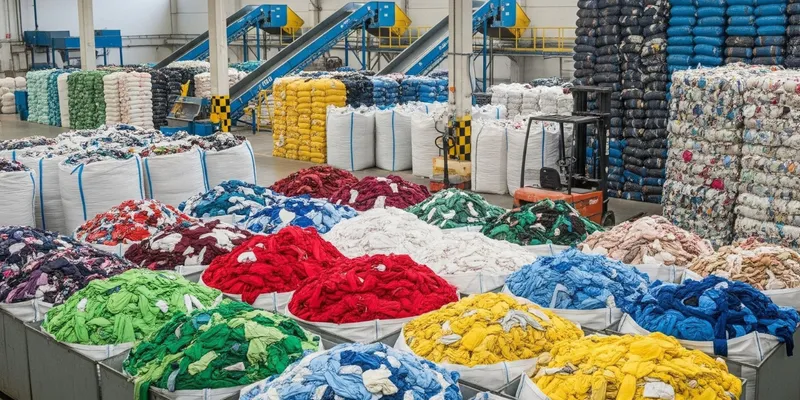
Initiative focuses on sorting and pre-processing infrastructure for post-consumer textile waste
Fashion for Good has introduced Project FAE (Feedstock Activation Europe) to address challenges in scaling textile-to-textile recycling. The initiative aims to develop sorting and pre-processing systems for non-rewearable post-consumer textiles. The project targets improvements in feedstock availability and quality for recycling processes.
Fashion for Good has launched Project FAE (Feedstock Activation Europe), an initiative designed to establish the infrastructure required to channel non-rewearable post-consumer textiles into textile-to-textile (T2T) recycling at scale. The project focuses on addressing limitations in the availability of suitable feedstock for recyclers.
Post-consumer textiles are typically sorted for rewearability, with reusable garments directed to resale markets. The remaining non-rewearable materials currently have limited processing options, with only a small proportion entering textile-to-textile recycling. A significant share is downcycled, landfilled, or incinerated. In addition, secondhand export markets are declining due to reduced material quality, trade restrictions, and weak demand in destination markets, leading to surplus volumes that often end up in landfills.
Although new recycling capacities are being developed across Europe, their utilisation depends on the availability of suitable feedstock. Current upstream systems for sorting, pre-processing, and supply are not sufficient to meet recyclers’ requirements in terms of cost and material specifications.
Post-consumer textile waste is heterogeneous and requires extensive processing, while recyclers have defined input requirements that vary by technology. This creates challenges for sorters, who face high collection and processing costs, and for recyclers, who require consistent and competitively priced feedstock. As a result, many recyclers continue to rely on post-industrial waste, which is more uniform and easier to process.
Demand for recycled fibres is increasing, supported by regulatory developments such as EU Extended Producer Responsibility legislation, which requires brands to take financial responsibility for products at the end of their lifecycle.
“We have been talking about textile circularity for years, and the honest truth is that the technology is no longer the bottleneck. What is holding us back is much more unglamorous: the sorting lines, the pre-processing steps, the supply systems that need to exist before a single fibre can be recycled. Project FAE is our attempt to tackle that unglamorous, necessary work head-on – together with the brands, sorters and recyclers who know this problem better than anyone. If we get this right, we unlock something the industry has been trying to reach for a long time.” Katrin Ley Managing Director at Fashion for Good
The project involves stakeholders across the value chain, including brand partners adidas (the lead sponsor), BESTSELLER, and INDITEX. Strategic partner Rehubs is also participating, with Rematters providing operational support.
Additional contributors include sorting organisations such as Boer Group, Circle-8 Textile Ecosystems, Erdotex, Formació i Treball, Humana People to People, Kringwinkel Antwerpen, New Retex, Nouvelles Fibres Textiles, Plaxtil-Essaimons, Sympany, Texaid, and Texlimca. Recycling companies involved represent mechanical, thermomechanical, and chemical processes, including Circ, Circulose, CuRe Technology, eeden, Infinited Fiber Company, Kipas (fibR-e), Matterr, Meltem Kimya, Recover, Reju, OnceMore from Södra, and WornAgain. The initiative is also supported by ecosystem partners such as InvestNL, Landbell Group, Refashion, Reverse Resources, TEXroad, Wargon Innovation, WRAP, ZDHC, and Global Fashion Agenda.
“Circularity will not be achieved through product innovation alone. The bigger and more urgent work is building the infrastructure that does not yet exist at the scale we need: sorting, pre-processing, and supply systems that enable post-consumer textile waste to move toward closed-loop recycling. This is not a challenge any single organisation can solve. Project FAE brings together the brands, sorters, and recyclers willing to work together to realize this pathway in the EU, and we are proud to be part of that work” Gudrun Messias; Director, Sustainability Direction at adidas AG
Project FAE operates across two key areas. The first focuses on improving feedstock preparation through advanced pre-processing techniques such as fibre blend separation, elastane removal, and contaminant extraction. The project will assess the technical and commercial viability of these methods.
The second area focuses on infrastructure development. The project will outline a framework for regional hubs across Europe that will manage large-scale sorting and pre-processing. These hubs are intended to aggregate textile waste, apply automated sorting technologies, and prepare feedstock tailored to different recycling requirements.
The hub model is designed to address cost and operational challenges faced by sorters by enabling scale and automation. It aims to improve feedstock quality, reduce processing costs per unit, and support more consistent supply for recyclers.
The project aims to deliver both technical insights and a commercial framework that can support the development of a post-consumer textile recycling value chain in Europe.
- Core Fashion & Textile Value Chain
- Circularity, Sustainability & Waste Management
- Sustainability Enablers & Solutions
- Technology, Platforms & Innovation
- Retail, Trade & Market Access
- Knowledge, Institutions & Ecosystem Builders
- Finance, Investment & Support
- Logistics, Infrastructure & Operations
- Media, Communication & Culture
- Others

 English
 Arabic
 French
 Spanish
 Portuguese
 Deutsch
 Turkish
 Dutch
Dutch
 Italiano
 Russian
 Romaian
 Greek
Greek