


India’s Cotton Acreage and Output Likely to Rise Next Season: USDA
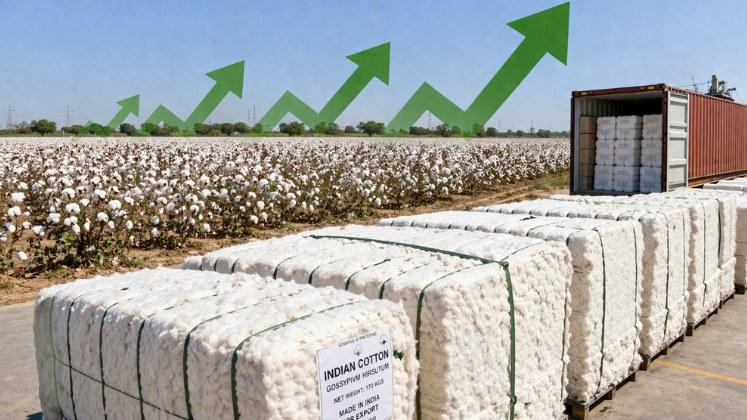
India’s cotton sector is expected to witness a recovery in the 2026–27 marketing year, with both acreage and production projected to increase, according to the United States Department of Agriculture (USDA).
In its latest assessment, the USDA has forecast a 3% rise in cotton acreage to around 11.5 million hectares, supported by improved farmer sentiment and expectations of better returns. Production is projected to grow by 7% to 25.2 million bales (480 lb each), driven by higher yields and a likely normal monsoon.
The increase in output follows a challenging previous season affected by untimely rains, with yields now expected to recover. The USDA has estimated average yields at approximately 477 kg per hectare, reflecting improved crop conditions and more favourable weather patterns.
Higher domestic demand is also expected to support the sector. Cotton consumption in India is projected to rise to 25.8 million bales, underpinned by stronger prospects for textile and apparel exports. Trade agreements with key markets such as the European Union and the United Kingdom are anticipated to further boost demand for value-added textile products.
On the trade front, cotton imports are expected to decline to around 3 million bales as improved domestic availability reduces dependence on overseas purchases. In contrast, exports are forecast to fall to approximately 1.2 million bales, reflecting a tighter exportable surplus and a strategic shift towards exporting higher-value textile products rather than raw cotton.
Overall cotton supply is projected to increase to nearly 39.3 million bales, supported by higher production and elevated opening stocks. Ending stocks are expected to rise further to 12.3 million bales, resulting in a stock-to-use ratio of about 46%, indicating comfortable availability in the domestic market.
Despite the positive outlook, the sector continues to face pressures from rising input costs and evolving fibre dynamics, including competition from synthetic alternatives. However, the anticipated improvement in yields and stable weather conditions are expected to underpin a more favourable outlook for India’s cotton economy in the coming season.
- Core Fashion & Textile Value Chain
- Circularity, Sustainability & Waste Management
- Sustainability Enablers & Solutions
- Technology, Platforms & Innovation
- Retail, Trade & Market Access
- Knowledge, Institutions & Ecosystem Builders
- Finance, Investment & Support
- Logistics, Infrastructure & Operations
- Media, Communication & Culture
- Others

 English
 Arabic
 French
 Spanish
 Portuguese
 Turkish
 Dutch
Dutch
 Italiano
 Russian
 Romaian
 Portuguese (Brazil)
 Greek
Greek