


Jan Vishwas Bill Eases Export Offence Penalties for textiles, handlooms
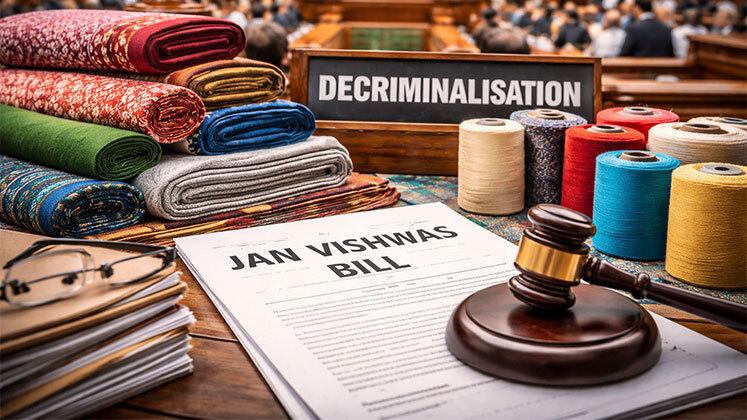
The latest iteration of the Jan Vishwas Bill has proposed the removal of imprisonment provisions for several offences linked to the export of textiles, handloom goods and agricultural products, signalling a continued push towards decriminalisation and ease of doing business.
Under the proposed changes to the Textiles Committee Act, penalties for exporting or selling textiles and textile machinery in contravention of prescribed orders will no longer include imprisonment of up to one year. Instead, authorities will issue a warning for the first contravention, with subsequent violations attracting a monetary penalty of up to Rs 25 lakh (US $26,000).
Similarly, amendments to the Handlooms (Reservation of Articles for Production) Act seek to eliminate custodial sentences for a range of compliance-related offences. These include failure to furnish information or samples, submission of false information, and damage to or refusal to produce books of account. Such violations will instead be subject to fines ranging between Rs 10,000 (US $105) and Rs 25,000 (US $263), replacing the earlier provision of imprisonment of up to three months.
The Bill also removes both imprisonment and fines for offences such as failure to produce books and records, as well as obstruction of officials or authorised personnel.
However, in cases involving the production of articles reserved exclusively for handloom manufacturing, the proposed amendments retain a custodial element, albeit with reduced severity. The term of imprisonment is set to be lowered from six months to three months, while fines are proposed to be increased from Rs 5,000 (US $53) per loom to a range of Rs 10,000 (US $105) to Rs 25,000 (US $263) per loom.
In addition, provisions under the Sea Customs Act, 1878 relating to the export of coir products without a licence or in contravention of regulations are proposed to be omitted. These offences are currently punishable with a fine of up to Rs 500 (US $5).
The proposed reforms reflect the government’s broader effort to replace criminal penalties with civil liabilities in order to improve regulatory compliance while reducing the burden on businesses.
- Core Fashion & Textile Value Chain
- Circularity, Sustainability & Waste Management
- Sustainability Enablers & Solutions
- Technology, Platforms & Innovation
- Retail, Trade & Market Access
- Knowledge, Institutions & Ecosystem Builders
- Finance, Investment & Support
- Logistics, Infrastructure & Operations
- Media, Communication & Culture
- Others

 English
 French
 Spanish
 Portuguese
 Deutsch
 Turkish
 Dutch
Dutch
 Italiano
 Russian
 Romaian
 Portuguese (Brazil)
 Greek
Greek