


US Demand for Indian Exports Remains Subdued Amid Policy Uncertainty and Trade Probes
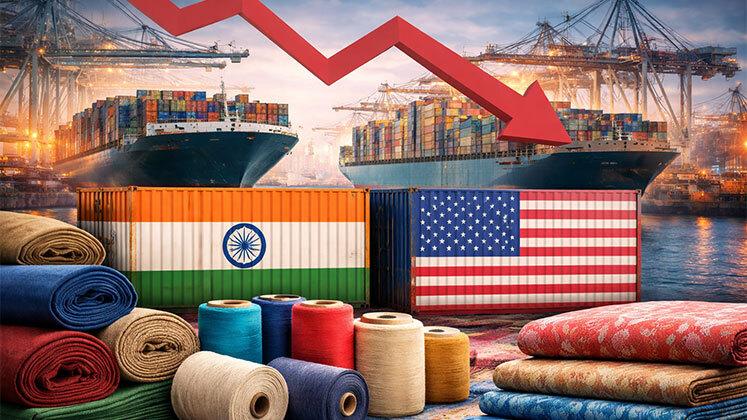
Demand for Indian exports in the United States continues to remain weak despite substantial tariff reductions, as policy uncertainty and geopolitical tensions dampen consumer sentiment, according to industry executives.
Textile shipments, in particular, have yet to recover, weighed down by excess inventories accumulated during the earlier 50% tariff regime and the ongoing Section 301 investigation. Data for the April–December period shows that textile exports declined by 16%, reflecting persistent headwinds in the sector.
Following the US Supreme Court’s rejection of former President Donald Trump’s tariff measures on imports, the Office of the United States Trade Representative (USTR) initiated Section 301 investigations. These probes aim to assess whether countries are maintaining “structural excess capacity” in manufacturing through mechanisms such as subsidies, wage suppression, or other trade-distorting practices.
Industry leaders indicated that these investigations are expected to constrain the pace of export recovery for sectors heavily reliant on the US market. While the textile industry has expressed cautious optimism regarding the current tariff framework, concerns persist over the potential implications of the ongoing probe.
Chandrima Chatterjee, Secretary General of the Confederation of Indian Textile Industries (CITI), stated that the Indian textile industry was closely monitoring the Section 301 investigations due to their potential impact on market access in the United States. She further noted that, should violations be identified, the US could impose punitive measures, including tariffs.
Chatterjee also observed that recent geopolitical developments, particularly in West Asia, alongside evolving US trade policies, had contributed to a cautious—if not bearish—market sentiment in the United States. This, she added, could moderate the pace of recovery and limit the full benefits of tariff rationalisation.
In response to concerns over excess capacity, India’s commerce ministry has gathered detailed data from affected industries. This includes information on installed capacities, integration within global value chains, policy support mechanisms, and employment levels. The objective is to demonstrate that the Indian textile sector does not contribute to global market distortions arising from surplus capacity.
- Core Fashion & Textile Value Chain
- Circularity, Sustainability & Waste Management
- Sustainability Enablers & Solutions
- Technology, Platforms & Innovation
- Retail, Trade & Market Access
- Knowledge, Institutions & Ecosystem Builders
- Finance, Investment & Support
- Logistics, Infrastructure & Operations
- Media, Communication & Culture
- Others

 English
 Arabic
 French
 Spanish
 Portuguese
 Deutsch
 Dutch
Dutch
 Italiano
 Russian
 Romaian
 Portuguese (Brazil)
 Greek
Greek