


Government Boosts Commercial LPG Allocation by 20% for Key Industries, Including Textiles
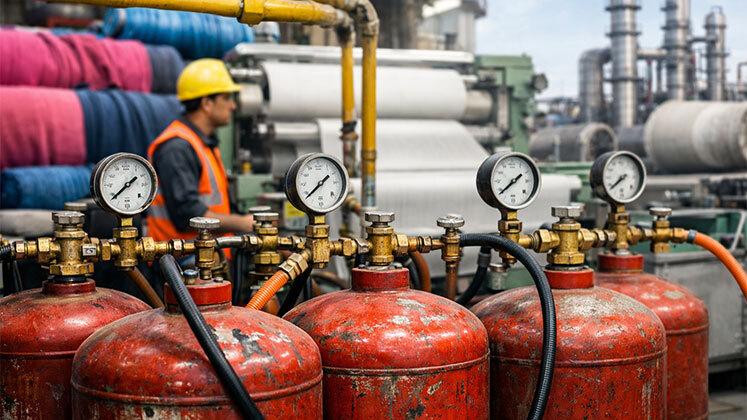
India’s Ministry of Petroleum and Natural Gas (MoPNG) has increased the allocation of liquefied petroleum gas (LPG) for commercial consumers by a further 20%, as it seeks to support critical industrial sectors amid ongoing global uncertainties.
The move builds on an earlier allocation of 40% of pre-crisis LPG supplies to commercial users. In addition, states have been offered an extra 10% allocation contingent on implementing reforms aimed at promoting piped natural gas (PNG) adoption.
In a communication to states, Oil Secretary Neeraj Mittal stated that the additional allocation would increase total commercial LPG supply to 70% of pre-crisis levels for packed non-domestic LPG. He indicated that the incremental supply would be directed towards labour-intensive sectors such as textiles, dyes, chemicals and more, which also support broader industrial ecosystems.
Mittal further noted that priority would be given to process industries and those requiring LPG for specialised heating applications where substitution with natural gas is not feasible. He added that companies would need to comply with conditions related to registration with oil marketing companies and applications for PNG connections through city gas distribution entities to qualify for the additional allocation.
However, he clarified that these conditions would be waived in cases where LPG usage is integral to industrial processes or specialised applications that cannot be replaced by natural gas.
Oil Minister Hardeep Singh Puri stated that the government’s decision to raise commercial LPG allocation was aimed at easing supply constraints, particularly for labour-intensive industries. He added that priority would be extended to sectors where piped natural gas is not a viable substitute.
Puri also noted that the global situation remains fluid, with the ministry closely monitoring developments in energy markets, supply chains, and essential commodities on a real-time basis.
- Core Fashion & Textile Value Chain
- Circularity, Sustainability & Waste Management
- Sustainability Enablers & Solutions
- Technology, Platforms & Innovation
- Retail, Trade & Market Access
- Knowledge, Institutions & Ecosystem Builders
- Finance, Investment & Support
- Logistics, Infrastructure & Operations
- Media, Communication & Culture
- Others

 English
 French
 Spanish
 Portuguese
 Deutsch
 Turkish
 Dutch
Dutch
 Italiano
 Russian
 Romaian
 Portuguese (Brazil)
 Greek
Greek