


Highlights For Textile Sector In India Budget 2026 - 27
Insights
- India's Union Budget outlines a multi-part integrated programme for textiles covering fibres, cluster modernisation, handlooms, sustainability and skilling.
- It proposes mega textile parks, support for khadi and rural artisans, duty-free inputs for shoe uppers, and extends export timelines for textiles, garments and footwear from six months to one year.
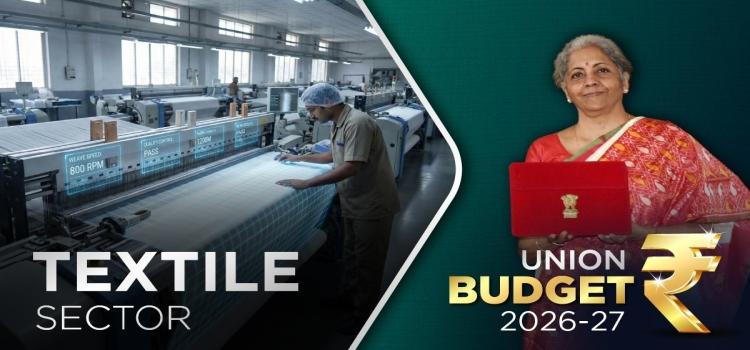
India’s Minister for Finance and Corporate Affairs, Nirmala Sitharaman presented her 9th consecutive Budget today. Textile sector related changes announced in her Budget speech are mentioned below:
1. For the labour-intensive Textile Sector, an Integrated Programme with 5 sub-parts has been proposed:
- The National Fibre Scheme for self-reliance in natural fibres such as silk, wool and jute, man-made fibres, and new-age fibres;
- Textile Expansion and Employment Scheme to modernise traditional clusters with capital support for machinery, technology upgradation and common testing and certification centres;
- A National Handloom and Handicraft programme to integrate and strengthen existing schemes and ensure targeted support for weavers and artisans;
- Tex-Eco Initiative to promote globally competitive and sustainable textiles and apparels;
- Samarth 2.0 to modernise and upgrade the textile skilling ecosystem through collaboration with industry and academic institutions.
2. Mega Textile Parks in challenge mode are to be set up. They can also focus on bringing value addition to technical textiles.
3. Mahatma Gandhi Gram Swaraj initiative will be launched to strengthen khadi, handloom and handicrafts. This will help in global market linkage and branding. It will streamline and support training, skilling, quality of process and production. This will benefit weavers, village industries, One - District – One - Product initiative and rural youth.
4. Duty-free imports will be allowed of specified inputs, which is currently available for exports of leather or synthetic footwear, to exports of Shoe Uppers as well.
5. The time period for export of final product has been extended from the existing 6 months to 1 year, for exporters of leather or textile garments, leather or synthetic footwear and other leather products.
6. The time period of export of textile/leather garments, leather/synthetic footwear or any other leather product by exporters is being extended from six months to twelve months.
- Core Fashion & Textile Value Chain
- Circularity, Sustainability & Waste Management
- Sustainability Enablers & Solutions
- Technology, Platforms & Innovation
- Retail, Trade & Market Access
- Knowledge, Institutions & Ecosystem Builders
- Finance, Investment & Support
- Logistics, Infrastructure & Operations
- Media, Communication & Culture
- Others

 Arabic
 French
 Spanish
 Portuguese
 Deutsch
 Turkish
 Dutch
Dutch
 Italiano
 Russian
 Romaian
 Portuguese (Brazil)
 Greek
Greek