


New labour codes aimed at easing supply chains and widening wage coverage - Labour Ministry advisor
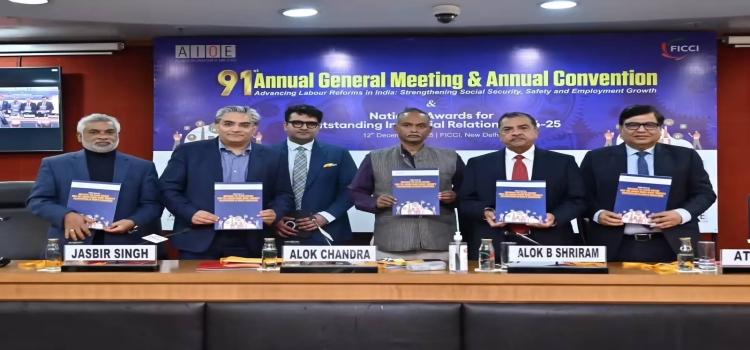
New labor codes consolidate 29 laws into four, aiming for frictionless supply chains, expanded skilling, and universal wage coverage. Employers anticipate simplified compliance and reduced burdens, while workers gain wider social security and recognition for gig work. India's reforms are internationally acknowledged for balancing equity and efficiency.
At the 91st Annual General Meeting and Annual Convention of the All India Association of Employers (AIOE), Alok Chandra, Senior Labour and Employment Advisor at the Union Ministry of Labour & Employment, said the new labour codes aim to create frictionless supply chains, expand skilling infrastructure and introduce universal wage coverage.
Chandra said the consolidation of 29 labour laws into four codes is intended to address regulatory inconsistencies that have affected industrial operations. He said the supply chain benefits arise from standardisation across the regulatory framework, with consistent definitions and national safety standards replacing multiple laws dating back to 1923.
"If there's consistency or congruence between the definitions as well as the safety standards which will ultimately govern the production process, this will facilitate a very smooth supply chain," Chandra said.
He added that a reskilling fund has been set up, partly financed through amounts credited after the compounding of offences. He said wage reforms represent a major expansion of worker protection, as minimum wages have been universalised across sectors, replacing the earlier system of 45 scheduled employments. The introduction of a national floor wage will prevent states from setting wages below the threshold, while allowing higher existing rates to continue.
"This floor wage to a very large extent addresses the issue of equity," he said, responding to concerns about wage disparities across regions.
Responses from employers and international bodies
Jasbir Singh, President of AIOE and Executive Chairman, CEO and Whole-Time Director of Amber Enterprises, said the codes create a structure that supports both enterprises and workers. He said employers will see simplified compliance and reduced regulatory burden, while workers will receive wider social security, safety measures and recognition of work arrangements including gig and platform work.
He said enabling measures will be needed, including state-level uniformity, phased implementation for micro, small and medium enterprises, a unified digital compliance system and capacity-building programmes.
Ravi Peiris, Officer in Charge, ILO DWT for South Asia and Country Office, India, said the codes create a foundation for a stable industrial relations system that balances equity and efficiency. "India has taken the lead in granting coverage for gig and platform workers," he said, adding that it reflects India's intention to reduce informality.
Atul Sobti, Director General of SCOPE and Member, ILO Governing Body, Geneva, referred to international acknowledgment of India's labour reforms. He said India has moved from an era of confrontation to one of consultation and cooperation, and highlighted employer responsibilities in reskilling for the energy transition and emerging technologies.
Akustina Morni, Director of Policy at the International Organisation of Employers, said India plays a constructive role in global labour discussions, including the G20 and ILO. She said she expects India to continue supporting a platform economy framework that enables business operations, particularly for micro, small and medium enterprises.
White paper released
AIOE and Shardul Amarchand Mangaldas & Co released a white paper titled Breaking the Glass Ceiling: How the Labour Codes Boost Women's Participation in India's Workforce. The paper examines how updated regulations, expanded social security and recognition of flexible work models support women's employment while outlining persistent issues such as care responsibilities and pay gaps.
- Core Fashion & Textile Value Chain
- Circularity, Sustainability & Waste Management
- Sustainability Enablers & Solutions
- Technology, Platforms & Innovation
- Retail, Trade & Market Access
- Knowledge, Institutions & Ecosystem Builders
- Finance, Investment & Support
- Logistics, Infrastructure & Operations
- Media, Communication & Culture
- Others

 English
 Arabic
 French
 Spanish
 Portuguese
 Deutsch
 Turkish
 Dutch
Dutch
 Italiano
 Russian
 Romaian
 Portuguese (Brazil)