


Weak rupee offers exporters marginal edge as input costs surge
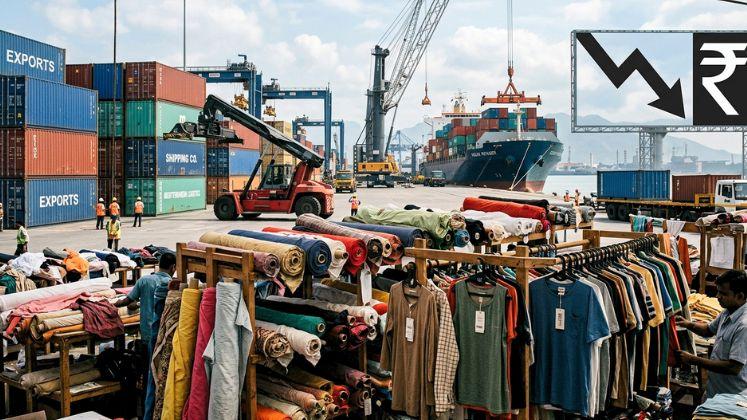
The Indian rupee has fallen to an all-time low against the US dollar, offering a marginal boost to export competitiveness while simultaneously raising concerns over higher input costs and weakening trade momentum.
Industry executives indicated that although the depreciation could improve price realisation for exporters, particularly in price-sensitive markets, the benefits are likely to be offset by rising costs of raw materials, energy and imported inputs.
Sectors such as textiles, leather,and more are expected to see some short-term gains, given their relatively lower dependence on imports. However, industries reliant on imported inputs—including petroleum and chemicals—are likely to face increased cost pressures due to a higher import bill and elevated crude prices.
Ajay Sahai, Director General of the Federation of Indian Export Organisations, stated that the low rupee provides a modest competitive advantage to Indian exports by improving price realisation, particularly in sectors such as textiles, leather, carpets, handicrafts and more and added that this could help support margins or market share in price-sensitive markets.
However, Pankaj Chadha, Chairman of EEPC India, indicated that the benefits would be limited, noting that exports could decline year-on-year due to disruptions in key markets such as the Middle East, while rising scrap and energy prices are making industrial operations more expensive.
Industry estimates suggest that only a small proportion of exporters—around 15%—remain unhedged and are therefore positioned to gain directly from the rupee’s depreciation. A representative from an export promotion agency stated that while the currency movement is mildly positive in the short term, it is unlikely to significantly alter the broader export outlook, as structural factors remain more critical to long-term growth.
Exporters also flagged additional pressure arising from earlier reductions in rates and value caps under the Remission of Duties and Taxes on Exported Products (RoDTEP) scheme, although the government has since restored these benefits. Sanjay Jain, Managing Director of TT Limited, noted that while the weaker rupee is theoretically positive, sharp increases in input costs—ranging from 10% to 50%—continue to weigh heavily on overall business conditions, limiting any meaningful relief.
The rupee’s depreciation comes at a time when India’s merchandise exports declined by 0.81% year-on-year to US $36.61 billion in February, with March expected to remain a challenging month for outbound shipments amid global uncertainties.
- Core Fashion & Textile Value Chain
- Circularity, Sustainability & Waste Management
- Sustainability Enablers & Solutions
- Technology, Platforms & Innovation
- Retail, Trade & Market Access
- Knowledge, Institutions & Ecosystem Builders
- Finance, Investment & Support
- Logistics, Infrastructure & Operations
- Media, Communication & Culture
- Others
 Dutch
Dutch
 English
 Arabic
 French
 Spanish
 Portuguese
 Deutsch
 Turkish
 Italiano
 Russian
 Romaian
 Portuguese (Brazil)
 Greek
Greek