


Swadeshi 2.0 India is no longer just a market, its a maker
Synopsis
India is in the middle of a Swadeshi 2.0 moment. Trade tensions abroad and a booming consumer market at home are pulling global manufacturers to set up shop here. Indian companies are seizing the moment with joint ventures and strategic stakes. Apple, VinFast, and Tesla are ramping up local operations, while the country pushes into high-value sectors like semiconductors.
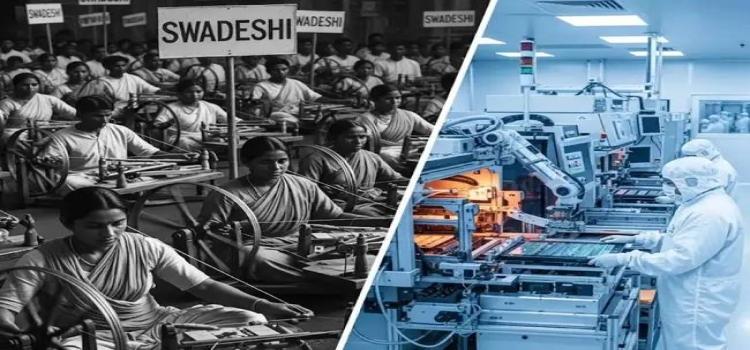
A century ago, the Swadeshi movement was a defiant act of resistance, urging Indians to boycott British goods. In 2025, the idea has evolved dramatically. It’s no longer about shutting the world out; it’s about drawing the world in, on India’s terms.
This shift is reshaping global commerce, verified not by rhetoric but by factory floors, joint ventures, and capital investment.
Global corporations aren’t just selling to India anymore, they’re making here. Supply chains are being reconfigured, bargaining power is shifting, and value creation is increasingly localised.
The geopolitical backdrop
Rising global trade tensions are amplifying this trend.
US President Donald Trump doubled tariffs on Indian goods to 50%, citing India’s discounted oil purchases from Russia. Washington views this as indirectly financing the war in Ukraine.
New Delhi, however, has stayed its course, signing fresh agreements to deepen economic cooperation with Moscow.
Indian firms in the driver’s seat
Swadeshi 2.0 isn’t about exclusion; it’s about control. The emphasis is on who commands capital, sets governance rules, and drives localisation. Foreign investment is welcome, but Indian hands remain firmly on the wheel.
Take the SAIC Motor–JSW Group automotive joint venture.
SAIC, the Chinese parent of MG Motor, reduced its stake in MG Motor India to 49%, while JSW acquired 35%. The remaining 16% is held by Indian investors, including financial institutions, employees, and dealers. Indian stakeholders now hold a collective majority, controlling strategy, governance, and operations.
Similarly, Tata-backed IHCL acquired a 51% stake in ANK Hotels Pvt Ltd and Pride Hospitality for ₹204 crore, planning to rebrand most properties as Ginger and expand to roughly 250 hotels.
Puneet Chhatwal, IHCL MD and CEO, frames it simply: to make Ginger “India’s number one mid-market brand serving 500 million potential customers in the next three to five years.”
Consumer goods illustrate the same principle.
Piccadilly Distilleries’ Indri whisky is now the world’s fastest-growing single malt, capturing a 30% market share in India and selling over one lakh cases within two years. Indian single malts now account for 53% of category sales, proving that homegrown brands can dominate both locally and internationally.
Global production, local control
The same playbook is playing out far beyond spirits. Whether in luxury goods, tech, or manufacturing, Indian companies and partnerships are building scale, meeting domestic demand, and earning global recognition, while keeping profits, decision-making, and influence at home.
One of the clearest examples is Apple’s expanding production footprint in India, a Make in India success story in motion. Government incentives, especially the Production-Linke Incentive scheme, have transformed the country into a hub for high-value electronics manufacturing.
Tata Electronics plays a pivotal role: after acquiring Wistron’s iPhone plant, it became Apple’s first Indian contract manufacturer and later took a 60% stake in Pegatron’s iPhone facility in Tamil Nadu.
Tata is also building a new iPhone plant in Hosur, significantly boosting production capacity. Taiwanese manufacturers Foxconn and Pegatron have invested heavily as well.
By late 2025, most iPhones sold in the US were made in India, a clear sign the country has become a global production hub, not just a sales market.
India’s appeal as a manufacturing base extends beyond electronics. Vietnamese EV maker VinFast has made India a launchpad for global expansion.
Its new Thoothukudi facility, part of a $500 million first-phase investment in a planned $2 billion expansion, went from groundbreaking to production in just 15 months. The 400-acre factory is explicitly designed for exports across South Asia, the Middle East, and Africa.
Tesla is also entering the fray.
After opening its first showroom in Mumbai in July and a second in Delhi in August, the company is signaling serious intent, even while selling China-made Model Ys at nearly ₹60 lakh. India’s reduction of import duties on high-value EVs, from 100% to 70%, makes local production a compelling prospect.
Additionally, high-value manufacturing is no longer optional; it’s central.
The Tata–PSMC semiconductor fab in Gujarat aims to roll out the first Made in India chip by late 2025, ahead of schedule.
Micron’s $2.75 billion assembly and test facility in Sanand is on track, and the Union Cabinet has approved four new semiconductor units with combined investment of ₹4,600 crore.
India is building strategic, high-value industries from the ground up, creating both domestic capacity and global relevance.
The Indian consumer
For decades, India was primarily a sales destination. That has flipped. Exports hit $825 billion in FY 2024–25, yet domestic consumption is now driving investment and strategic decisions.
The RBI projects 6.5% GDP growth in FY 2025–26. An Edelweiss report estimates India’s consumer market will be the world’s second largest by 2030. Festive sentiment surveys show 92% of consumers plan to maintain or increase spending in 2025, with average budgets around ₹16,500.
The message is clear: produce for India first. Global firms are adjusting, and India has become a driver of strategy, investment, and production decisions.
Why India is attracting global business
McKinsey highlights three core advantages: talent, consumers, and infrastructure. Trade-flow shifts could bring $0.8–$1.2 trillion by 2030 and raise manufacturing’s GDP share from 16% to 25%.
About one-third of the world’s STEM graduates are Indian.
Engineering, R&D, and sourcing could jump from $44–45 billion today to $130–170 billion by 2030.
Infrastructure investments of $1.8 trillion by 2025 are modernising ports and logistics. Monthly household consumption has climbed from $271 in 2012 to $705 in 2023, reflecting India’s massive population and rising GDP.
India as an outward investor
India’s outbound investments are surging and diversifying.
In FY25, they jumped 75% to ₹2,51,412 crore ($29.2 billion). Outbound deals aren’t capital flight, they widen market access, bring technology home, and professionalise supplier networks.
In FY26 (April–May 2025), actual ODI reached ₹46,321 crore ($5.38 billion), with Singapore, Mauritius, and the US as top destinations.
Notable moves include Aditya Birla Group’s $50 million R&D centre in Texas and Essar–Kowa’s $8.5 billion green hydrogen joint venture.
The bottom line
The first Swadeshi was about buying Indian. The current phase is about building with India. Partnerships, factories, and investments show that global companies no longer have to choose between selling to India and producing elsewhere.
To stay relevant in one of the world’s most dynamic markets, they are making in India, and seeing the country’s shift from being just a large market to becoming a significant producer.
- Core Fashion & Textile Value Chain
- Circularity, Sustainability & Waste Management
- Sustainability Enablers & Solutions
- Technology, Platforms & Innovation
- Retail, Trade & Market Access
- Knowledge, Institutions & Ecosystem Builders
- Finance, Investment & Support
- Logistics, Infrastructure & Operations
- Media, Communication & Culture
- Others
 Portuguese
 English
 Arabic
 French
 Spanish
 Deutsch
 Turkish
 Dutch
Dutch
 Italiano
 Russian
 Romaian
 Portuguese (Brazil)
 Greek
Greek