


Textile ministry sets up taskforce for sustainable fashion
On National Handloom Day, the textile ministry launched a sustainability-focused exhibition and ESG taskforce to promote circularity in fashion. The “Weave the Future” event celebrates regenerative handloom practices, indigenous cotton, and artisan-led innovation in textiles.
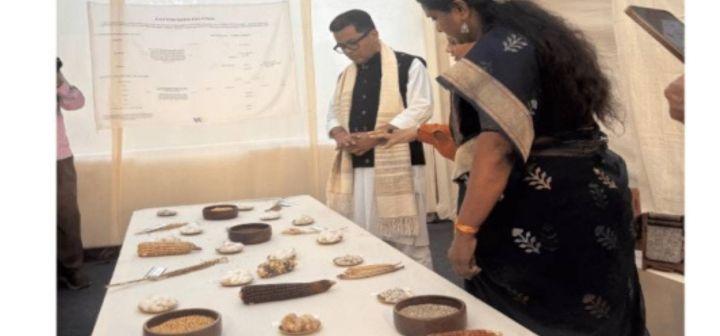
Pabitra Margherita, minister of state for textiles, at an exhibition in New Delhi Friday.
Marking National Handloom Day, an exhibition titled Weave the Future – Regenerative Edition, where the spotlight is on handlooms as key drivers of sustainability and circularity in the textile industry, was inaugurated on Friday in the national capital.
This year’s edition, held at the Crafts Museum, New Delhi, is a step towards celebrating a new tribe of textile artisans who are reimagining the future of fashion through regenerative and handmade practices.
From installations on textile innovation, climate-conscious weaving, and digital tools for artisan marketing, the event is a showcase of how handloom is embracing the future.
A multi-stakeholder ESG taskforce launched
The event was inaugurated by Pabitra Margherita, minister of state for textiles.
In response to a question in Rajya Sabha today, the minister informed the house, that the ministry of textiles had constituted an environmental, social, governance (ESG) taskforce, a multi-stakeholder platform, with the objective of identifying hotspots in the textiles value chain and relevant stakeholders and interventions needed to minimise the negative impact on the environmental and social front.
“There are a number of pilot projects in collaboration with various developmental agencies being facilitated for management of textile waste, including setting up of textile recovery facilities (TRFs), promoting upcycled products, capacity building of stakeholders on textile circularity,” he said.
Speaking about the cultural significance of India’s handloom traditions, M Beena, development commissioner for handlooms, ministry of textiles, said, “This platform not only honours our weavers and our heritage but also sparks vital conversations around sustainability, circularity, and regenerative practices. This initiative represents collective commitment towards shaping a future where handlooms are not celebrated as a craft, but as a living system of knowledge, community, and ecological harmony.”
Indigenous cotton and artisan voices at the forefront
The first edition last year focused on upcycling. This year the edition champions traditional alternatives—honouring the wisdom of land and people. The exhibition displays India’s textile traditions in heritage weaves like khadi, chanderi, paithani, etc, to contemporary interpretations by young designers, bringing 30 participating brands and initiatives, including weavers, artisans, designers, enablers, and storytellers, committed to reviving and sustaining regenerative textile practices.
The handloom sector employs over 35 lakh people across India, with more than 70% being women. It remains a vital source of sustainable livelihoods, women’s empowerment, and eco-friendly production, while preserving India’s rich cultural heritage.
Unlike most exhibitions, the heroes of the exhibition weren’t anonymous labels, they were the weavers themselves. “These are not just craftspeople. They are storytellers,” said Shubhi Sachan founder, Material Library of India, who is part of the exhibition. She added, “It’s a revival of regional, seasonal and original ideas that offer a blueprint for this show.
The event features indigenous cotton varieties such as kala cotton, punasa cotton, konda patti cotton, and gavran kapus cotton which is a drought-resistant crop supporting ecological balance besides featuring responsible brands such as Dhi Earth, Lafaani, Johargram and more committed to ethical design and storytelling.
Indigenous cotton varieties make up just 2–3% of India’s total cotton cultivation today. Through this edition, the organisers aim to raise awareness and build momentum to increase this share in the coming decade. These cottons require fewer pesticides, support biodiversity, and are better suited to local climates. Beyond farming, the exhibition also underscores the importance of decentralised, low-cost, and energy-efficient processing technologies that empower rural communities and maintain local and self-reliant value chains.
Apart from this, the event is hosting a soundscape installation by fashion and textile designer Sonam Khetan, depicting the disappearing sounds of the natural world as a result of human activities, along with a workshop on deep-rooted relationship between indigenous cotton and millets by OOO Farms.
- Core Fashion & Textile Value Chain
- Circularity, Sustainability & Waste Management
- Sustainability Enablers & Solutions
- Technology, Platforms & Innovation
- Retail, Trade & Market Access
- Knowledge, Institutions & Ecosystem Builders
- Finance, Investment & Support
- Logistics, Infrastructure & Operations
- Media, Communication & Culture
- Others

 Arabic
 French
 Spanish
 Portuguese
 Deutsch
 Turkish
 Dutch
Dutch
 Italiano
 Russian
 Romaian
 Portuguese (Brazil)
 Greek
Greek