


Software: Powering Textile & Fashion’s Future

Key Takeaways
- AI-powered ERP and PLM platforms are transforming textile and apparel operations by linking design, sourcing, production and sales in one digital ecosystem.
- Predictive analytics, automation and real-time visibility improve inventory, planning, quality and sustainability, while cloud-based systems help manufacturers respond faster to market changes, strengthen compliance and reduce costs.
Technology has evidently revolutionised the global textile and fashion industry over the years by accelerating production, minimising waste, and enabling on-demand, sustainable manufacturing. From AI-driven design tools and robotic laser cutters to climate-responsive smart fabrics, digital advancements have transformed traditional textile and apparel creation into a highly efficient, data-driven global ecosystem.
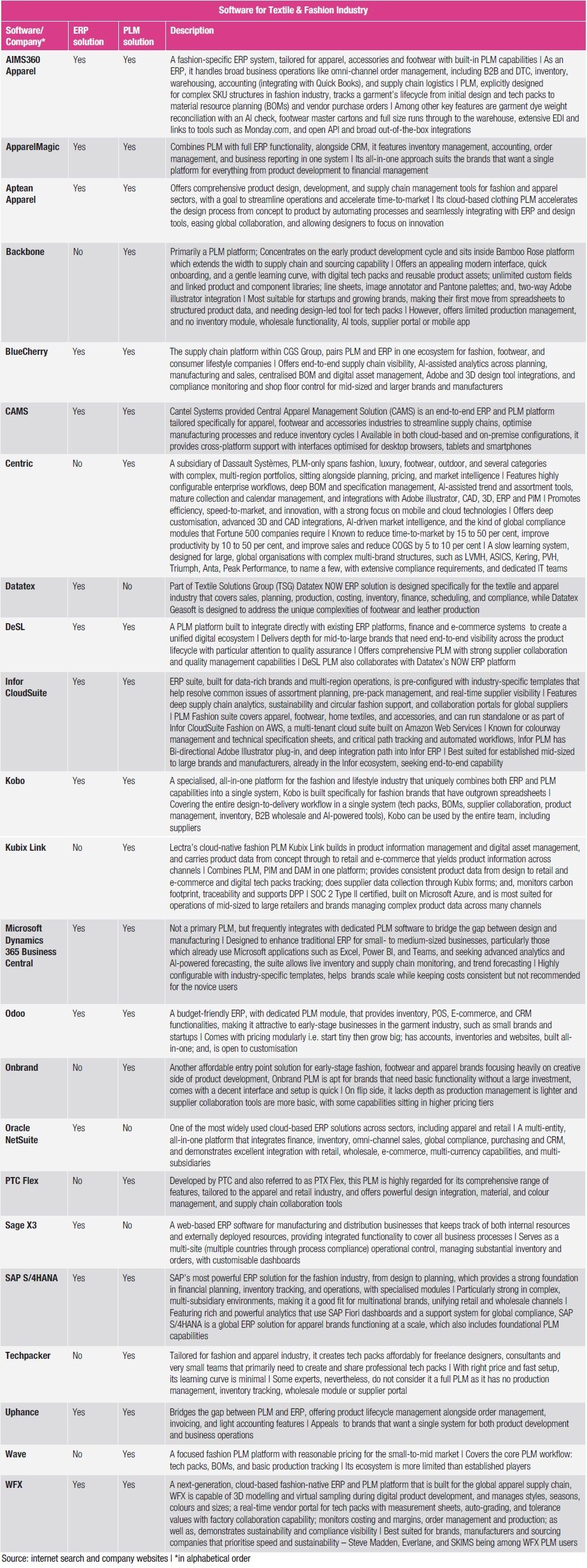
Technology tools are available for all stages in the textile and apparel value chain, driven by latest machinery and hardware running on ever-advancing software—their lifeline, which play a crucial role in the IT-centred environment. They are driving today’s modern industry as its entire business operations and product development heavily depend on them. Among many software that support the industry, PLM (Product Lifecycle Management) for product development, and ERP (Enterprise Resource Planning) for comprehensive manufacturing management and overall business operations, stand out.
While an ERP handles core business operations, managing the transactional, financial, and supply chain processes required to manufacture and deliver that product to market, a PLM software manages the entire lifecycle of a product from initial design and engineering through production to service and retirement. Although both are distinct systems with opposite architectures, they very well complement each other. This is why companies keep these platforms tightly integrated, even if they are separated, to allow them work together. Playing a bigger role, many ERP solutions already have built-in PLM capabilities, while some have features to allow integration with other PLM systems, both capable of triggering a cascading effect of an event in the entire operation. For instance, when an engineer updates a component design in the PLM system, that change is instantly pushed to the ERP system so that purchasing teams can order the correct new materials and manufacturing floors can adjust production schedules.
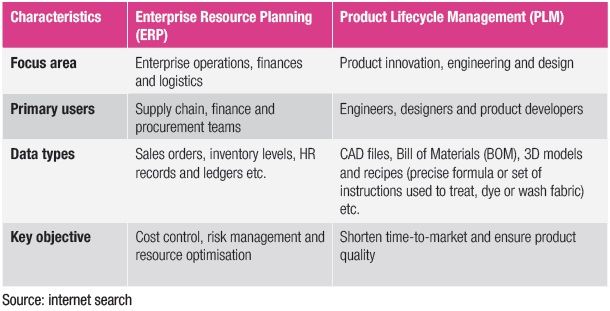
In fashion, PLMs seamlessly integrate with 3D fashion design software, creating a powerful toolset for fashion companies looking to innovate, reduce costs, and improve their products’ overall quality and sustainability. Valued1 at $826.86 million in 2023, PLM in fashion market size is projected to reach $1,485.29 million by 2031, growing at a CAGR of 7.61 per cent between 2024 and 2031.
PLMs make much more sense in the fashion industry today with trend cycles turning over faster than the product development calendars, margins squeezed by material and mounting labour costs, sourcing also spreading across more countries and more tiers, and sustainability rules now asking for evidence rather than intent, especially across the EU, the old way of building product, spreadsheets, scattered emails and offline approvals are no more relevant. This is where PLMs come in, which keep garments’ whole development record in one place across the collection lifecycle, encompassing the first sketch and tech pack, the materials and BOMs, costing, samples, approvals and compliance, right through to the handover to production. Design, merchandising, sourcing, and production all work from the same record, and so do the suppliers they depend on. According to estimates, PLM-driven product development can save up to 50 per cent on sampling costs and reduce time-to-market by 30-40 per cent.
Modern day apparel and fashion industry is a fast-paced and evolving industry, in which controlling design, production, inventory, distribution and finance in a single system has become a necessity. This is achieved through ERP systems that bring together all key functions and allow businesses, such as garment manufacturers, fashion houses, and clothing retail and export traders, to operate more effectively. Adoption of ERP solutions has reduced costs of businesses as they now manage the business processes end-to-end and provide a better customer experience by responding quickly to consumer demand.
The leading platforms today combine ERP and PLM, 3D design, sourcing collaboration, real-time production tracking, and sustainability reporting into a single system, thereby pushing ERP solutions to evolve beyond an old-fashioned accounting software, that could also track sales, inventory, and related data. Consequently, global apparel ERP software market, valued2 at $4.3 to 6.1 billion in 2026, is expected to grow at a CAGR of about 7.8 to 11.9 per cent during the early-2030s period, driven by the rise in digitalisation across fashion supply chains. With fashion organisations’ continuous move to real-time analytics, omni-channel tools and advanced supply chain modules, their migration to cloud-based, AI-enabled ERPs are becoming a must-have.
Limitation of Traditional ERP Systems
Although many textile manufacturers still rely on traditional ERP systems, they pose some limitations, such as inflexible processes which slow down operational change, high customisation and upgrade costs, manual workarounds that introduce errors and inefficiencies, and fragmented data that prevents real-time operational visibility. For many manufacturers, traditional ERP systems are fast becoming a burden, hindering manufacturing growth as they fail to respond quickly to changing market conditions. They happen to be reactive, data-heavy and less intelligent to be an effective solution for contemporary apparel businesses. Further, they rely on past data and manual inputs. By the time insights come in, it is often already too late, leading to various issues, such as overstocking at some places and stock outs in others, as well as slow reactions to what the market actually needs. This also leads to data silos in textile manufacturing, where information becomes difficult to align across departments. When production cycles shorten and ESG requirements intensify, these limitations create structural bottlenecks. This has pushed the textile and fashion industry to shift to AI-powered ERP solutions.
The fast developing AI-driven ERP systems can transform data into live intelligence. For apparel manufacturers, this means greater agility, lower costs and quicker time-to-market. Gartner estimates that every year clothes makers produce about one-fifth to almost a third more than needed, and messed-up inventory, resulting in overstocking and stock outs, wiping out nearly $1.1 trillion across retail worldwide. In such a scenario, AI can reduce inventory level by 20 to 30 per cent, besides improving service levels. And with companies, using AI in supply chains, also ending up in 15 per cent lower logistics costs, AI-powered apparel manufacturing ERP software are making a strong case for themselves. Additionally, McKinsey estimates that predictive supply chains can avoid forecasting errors by 20 to 50 per cent with integrated modern AI-ERP Dashboards, and companies using AI-driven personalisation can benefit from 5 to 15 per cent revenue growth.
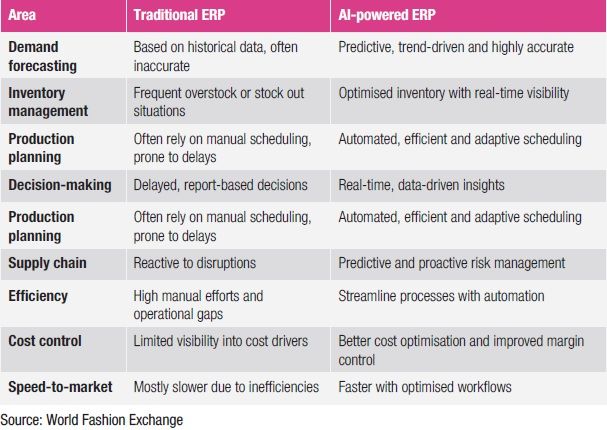
With integration of AI within apparel ERP, the system transforms from a simple data management tool into an intelligent decision-making engine, equipping leaders with up-to-the-minute dashboards and predictive analytics powered by machine learning that easily adapt to evolving needs. It constantly checks for data from design, production and sales, and learns from historical and real time business data. The AI-enhanced ERP solution automatically predicts anomalies, reflects past data, and predicts future strategy trends. The system eliminates manual interpretations and operational decisions with combined action-based data.
Weaving textile businesses face unique challenges, from managing complex production schedules and raw materials to maintaining quality control and meeting customer demands. Traditional methods of managing weaving schedules, raw materials, and labour allocation often lead to inefficiencies, delays and increased costs. By incorporating AI into their ERP system, weaving textile businesses can streamline operations, optimise processes and gain a competitive edge in an increasingly demanding market.
AI-powered ERP systems utilise predictive analytics to forecast demand and optimise production schedules. By analysing historical data, AI predicts when raw materials will be needed, how much inventory to maintain, and the best times to run specific production lines, helping businesses plan more effectively and minimise downtime. To manage inventory better, AI-powered ERP systems analyse historical inventory data to predict future needs, optimising stock levels to avoid overstocking or stock outs. They also automate the reordering process by identifying when stock levels are low, placing orders with the suppliers, and ensuring a seamless flow of materials without delays.
In order to maintain high-quality standards in weaving operations to ensure customer satisfaction and minimising returns, AI significantly enhances quality control by utilising image recognition technology to inspect fabrics during production. By using cameras or sensors to capture images of woven fabric, AI detects defects such as irregularities, colour mismatches, or flaws in the weave. The system automatically alerts operators to address issues in real time, ensuring that defective goods are not shipped and that quality is consistently maintained.
Many tasks in textile production are time-consuming and prone to human error. The repetitive tasks in textile production, such as data entry, report generation, and inventory updates, are automated by AI in ERP systems, freeing up valuable human resources for more strategic decision-making. AI also helps in handling routine administrative work like generating sales invoices, updating stock levels, and processing customer orders, resulting in faster operations and fewer mistakes.
Other Deliverables of AI-powered ERPs
Customer Experience: AI-powered CRM integration within ERP systems elevates customer experience by analysing customer preferences, purchase history, and trends to recommend products or services that best match their needs. Businesses get direction in offering targeted marketing campaigns, personalised promotions and better customer service, building stronger relationships and improving customer loyalty.
Meaningful Insights: The basic operational data of traditional ERP systems is turned into actionable insights, by analysing patterns, identifying correlations, and generating production, inventory, pricing strategies, and new market opportunities. AI-driven decision-making enhances agility of businesses when it enables them to respond quickly to market changes.
Supply Chain Management: By analysing data from multiple sources, including supplier performance, inventory levels, and shipping schedules, AI can recommend the best suppliers, track delays, and anticipate disruptions. Its capability to foresee potential supply chain challenges allows businesses to make proactive adjustments, ensuring that production stays on track and delivery schedules are adhered to.
Demand and Trends Forecasting: Extremely effective in forecasting demand with high accuracy, AI can spot emerging trends sooner, allowing manufacturers, retailers and brands to get ahead of them. By studying how demand has changed over time, and analysing historical sales data, seasonal trends and external market signals, the AI-powered systems can give more realistic estimate thereby plugging overproduction, thus saving costs.
Inventory Tracking and Optimisation: To check dead-stock levels and ensure availability of in-demand stock, AI-powered systems, driven by multi-level optimisation algorithms, can evenly distribute inventory across sites. Simultaneously, restocking decisions happen without delay, with automatic replenishment decisions taken at every stage of the supply chain by real-time tracking of demand signals and stock movement. This improves inventory turnover and reduces holding costs. In a manufacturing setup, the system gives real-time updates on raw material availability, work-in-progress, and finished goods per lot container: batch wise, order wise, besides taking care of sales order entries considering colour size combinations, creation of preformed and sales invoices, shipping document, picking of finished goods, packing list generation, handling letter of credit facilities etc.
Production Planning and Scheduling: AI-powered ERP provides fresh insights from the shop floor and shapes how tasks unfold to streamline schedules without delay. Using constraint-based planning in combination with real-time shop floor data, production scheduling is automated which, in turn, improves capacity utilisation. The system enhances production cycles by identifying and resolving bottlenecks using simulation models and performance analytics; earmarks starting and ending dates of production; as well as, calculates waste and tracks production progress. Further, AI can monitor machine performance in real-time, and detect early signs of wear and tear or impending breakdowns to predict when the maintenance is needed. This reduces the likelihood of unexpected downtime, prolonging the life of equipment.
Quality Control: AI-enabled computer vision models, trained on fabric and garments dataset, detect real-time defects with greater accuracy than manual checks, minimising rework, maintaining better quality consistency, and significantly reducing reliance on human inspection. AI matches quality checks by cross-verifying outputs with predetermined metrics, quelling human errors and inconsistencies.
Supplier and Vendor Management: Whether it is a supplier, supplying raw materials or components to business, or a vendor, selling finished garments, the system evaluates them based on their past performance, adherence to deadlines and quality standards to identify the most reliable of them. The performance scoring models around delivery timelines, quality metrics and compliance data are utilised to guide more reliable sourcing. Vendor management is also kept proactive using advanced analytics to predict supply chain risks using both historical and real-time data.
Profitable Costing and Pricing: A crucial area for the manufacturers to stay competitive as well as profitable, it is achieved by calculating accurate product costs after evaluating material, labour and operational costs at every stage of production to yield better cost control. If needed, an alternate perfect pricing methods can also be suggested by the ERP system. By analysing demand patterns and market trends, higher margins can also be planned.
Refunds Reduction: At retail point, return of fashion items is a big problem, arising mostly due to wrong fit. AI enables greater accuracy in evaluating fit and sizing trends based on customer feedback, returns data and even pattern analysis. By doing so, it improves the overall accuracy of product offerings. AI uses data clustering and analysis to provide insights into repeat product issues, helping reduce product returns, waste, and even reverse logistics costs.
Conclusion
Modern ERP platforms will continue adopting cloud-native architectures and integrating strict cybersecurity to manage the complex, multi-stage supply chains in the apparel and textile sectors. ERPs will increasingly integrate AI and ML (Machine Learning) capabilities for predictive maintenance of heavy machinery, and AI-driven demand forecasting to minimise fabric wastage. ERP-PLM’s real-time analytics and more advanced specialised modules will track energy consumption, water usage and carbon emissions to comply with global ESG regulations. They will provide green ERP and sustainability tracking options too, appealing to eco-conscious consumers. Contributing to enhanced traceability, advanced systems are expected to utilise full-chain transparency, vital for quality control and strict regulatory compliance.
- Core Fashion & Textile Value Chain
- Circularity, Sustainability & Waste Management
- Sustainability Enablers & Solutions
- Technology, Platforms & Innovation
- Retail, Trade & Market Access
- Knowledge, Institutions & Ecosystem Builders
- Finance, Investment & Support
- Logistics, Infrastructure & Operations
- Media, Communication & Culture
- Others

 English
 Arabic
 French
 Spanish
 Portuguese
 Deutsch
 Turkish
 Dutch
Dutch
 Russian
 Romaian
 Portuguese (Brazil)
 Greek
Greek