


A New Approach To Textile Wastewater: Direct-to-Reuse and ZLD at fractional cost by Vimarsh Verma and Haresh Shandilya
India’s textile industry plays a critical role in employment generation, exports, and GDP contribution. However, its high water consumption and wastewater generation continue to present serious environmental and operational challenges. Fabric processing operations — especially dyeing, washing, and finishing — require vast quantities of water and discharge effluents with high chemical loads and Total Dissolved Solids (TDS).
Traditionally, Zero Liquid Discharge (ZLD) systems have been implemented to manage this effluent and recover water. Yet, conventional ZLD architectures involve substantial capital investment, energy use, and chemical handling — making them impractical for the micro and small enterprises that dominate India’s textile landscape.
What’s now emerging is a new paradigm: scientifically rigorous, compact, and direct-treatment systems that can operate at near-zero cost in the future. With India’s accelerating adoption of solar, wind, and hybrid renewables, the cost of electricity — a primary operating input in thermal-based treatment — is projected to decline significantly. This presents a unique opportunity: achieving high-efficiency wastewater recovery without economic burden.
A shift is needed — not just in how we treat textile effluent, but in how we approach water circularity in the era of cheap and clean energy.
Limitations of Conventional ZLD Architectures
Most ZLD systems in the textile sector follow a multi-stage approach:
- Effluent Treatment Plant (ETP): Removes suspended solids and partially treats chemical load.
- Reverse Osmosis (RO): Separates clean permeate from concentrated brine.
- Multi-Effect Evaporator (MEE): Treats RO reject through thermal evaporation.
- Dryer/Crystallizer: Converts concentrate into solid waste.
While functionally effective, these systems have considerable drawbacks:
- High land requirement
- Multi-stage energy consumption (pumps, chillers, thermal evaporators)
- Use of chemicals and frequent membrane replacements
- Dependence on skilled manpower
- Inconsistent recovery efficiencies across varying TDS loads
For units with effluent volumes between 5–500 KLD — typical of decentralized hubs like Tirupur, Ahmedabad, Surat, Ludhiana and Pali— these models are financially and logistically burdensome.
A Direct and Modular Alternative: MVR-Based Low-Temperature Evaporation
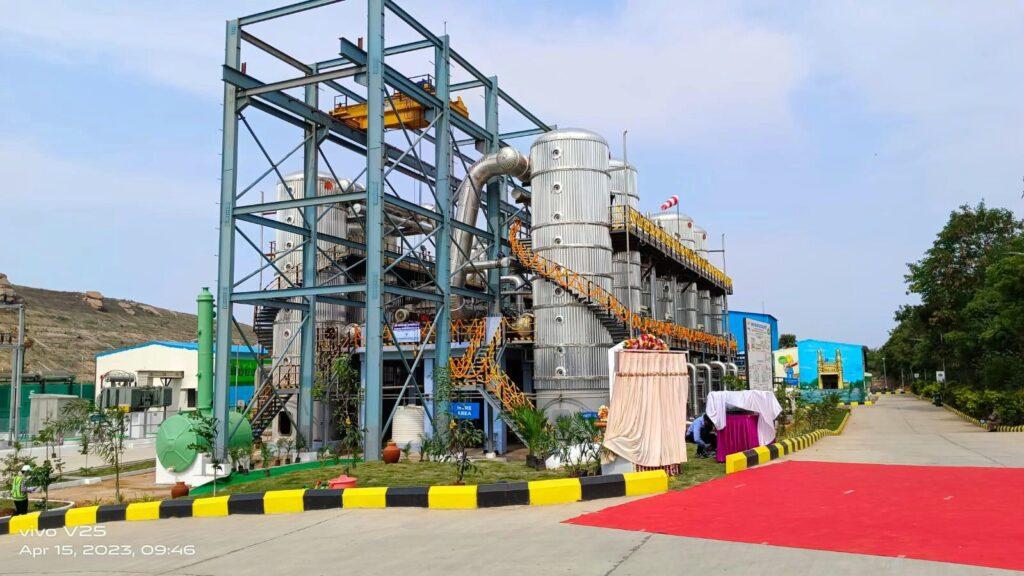
SEDL has developed a single-stage, low-temperature evaporation system using Mechanical Vapor Recompression (MVR) technology that bypasses the ETP–RO–MEE–dryer sequence entirely.
Key Process Characteristics:
- Direct Effluent Input: No pretreatment required; raw effluent is fed directly into the unit.
- Low-Temperature Evaporation: Operates under vacuum conditions at ~65–75°C.
- MVR Technology: Reuses latent heat of the vapor to sustain evaporation, reducing net energy input.
- High Water Recovery: Achieves >99% recovery with permeate TDS < 50 ppm.
- Solid Waste Minimization: Generates minimal residue, easily collectable for safe disposal.
- Hot Water Generation: Hot condensate clean water up to 90°C can also be generated from the system.
This solution significantly reduces system complexity while maintaining compliance with water reuse norms.
System Design and Operational Advantages
Notably, the system performs consistently across wide-ranging effluent compositions — from low TDS (<10,000 ppm) to very high TDS effluents (>100,000 ppm).
Impact of Electricity Cost on Viability
Energy consumption is a major determinant of treatment cost in thermal-based systems. The MVR system is designed for optimal energy reuse, but the economics improve significantly under subsidized or renewable electricity regimes.
In states offering textile sector power subsidies or in units with solar adoption, the cost of water recovery can drop to negligible levels — offering strong incentive for decentralized circular water systems.
With the advent of renewables, and reducing electricity costs to the future projected ₹1/kWh, the overall running cost of the MVR-LTETM falls dramatically — bringing treatment cost to near-zero levels and making water recovery virtually cost-free in optimal conditions.
Field Validation and Adaptability
To date, over 50 installations of SEDL’s MVR-based evaporators have been operationalized in varied textile environments — including dyeing houses, printing units, fabric finishing lines, denim and silk units.
Performance Highlights:
- Locations: Tamil Nadu, Gujarat, Punjab, Maharashtra, Rajasthan
- Capacities: 5 KLD to 500 KLD per module
- Water Quality: <50 ppm TDS, reusable for dyeing/boiler operations
- Residue Volume: <1% by input volume
- Recovery Rate: >99% consistently across effluent variability
These systems are designed to operate reliably in decentralized environments with minimal technical oversight, offering a replicable model for sustainable water management.
Toward Decentralized Water Circularity in Textiles
India’s textile landscape is highly fragmented. Solutions built for large centralized plants often fail to meet the ground realities of smaller manufacturers — who nevertheless face identical compliance expectations.
By combining scientific process engineering with operational simplicity, MVR-based systems enable a new class of effluent treatment: decentralized, chemical-free, low-maintenance, and energy-efficient.
This shift aligns with broader sustainability goals:
- Reduced freshwater withdrawal
- Near-zero wastewater discharge
- Lower carbon and chemical footprint
It also offers resilience — protecting units against tightening environmental regulations and water scarcity pressures.
Conclusion
Effluent management in textiles no longer requires bulky, multistage infrastructure or high recurring costs. The evolution of mechanical vapor recompression and low-temperature evaporation offers a credible, technically robust, and field-validated alternative — particularly suited for decentralized operations.
- Core Fashion & Textile Value Chain
- Circularity, Sustainability & Waste Management
- Sustainability Enablers & Solutions
- Technology, Platforms & Innovation
- Retail, Trade & Market Access
- Knowledge, Institutions & Ecosystem Builders
- Finance, Investment & Support
- Logistics, Infrastructure & Operations
- Media, Communication & Culture
- Others
 Spanish
 English
 Arabic
 French
 Portuguese
 Deutsch
 Turkish
 Dutch
Dutch
 Italiano
 Russian
 Romaian
 Portuguese (Brazil)
 Greek
Greek