


The Machine That Makes It All: Inside the Spinning Machinery Value Chain
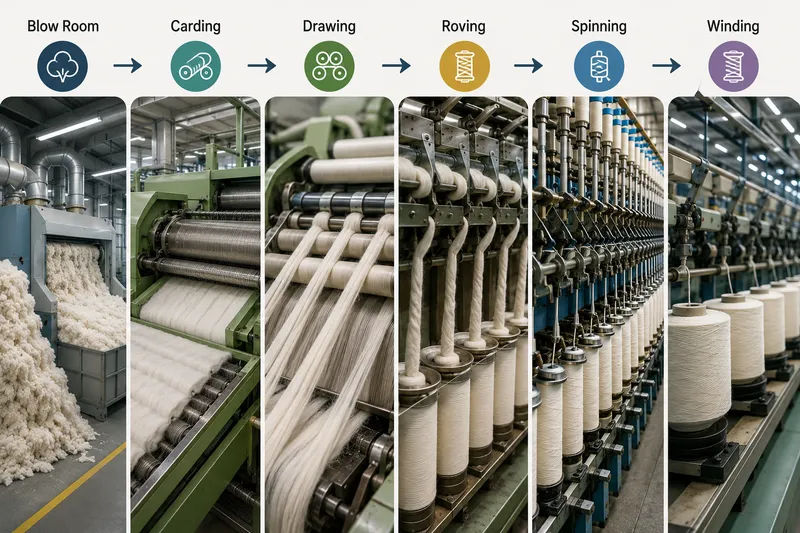
Before a shirt is stitched, before a fabric is woven, before a loom even turns — there is yarn. And yarn begins with spinning.
Think of spinning as the very first real act of making a textile. You take a loose, fluffy mass of raw fibre — cotton, polyester, wool, viscose — and twist, pull, and compress it into a continuous thread strong enough to be woven or knitted into something wearable. That transformation doesn’t happen by hand anymore. It happens inside a spinning machine, and the industry that builds and operates these machines is worth serious money.
The spinning machinery market stood at USD 13.77 billion in 2025, and is estimated to reach USD 14.4 billion in 2026, with projections to hit USD 18.01 billion by 2031 at a CAGR of 4.57% — based on the latest Mordor Intelligence update. That’s not a niche corner of manufacturing. That’s foundational infrastructure for every textile product on earth.
The Spinning Process
Inside a spinning mill, fibre moves through a fixed sequence:
Blow Room → Carding → Drawing → Roving → Spinning → Winding
Raw fibre bales arrive compressed and tangled. Blow room machines open and clean them. The carding machine combs out the fibres into a thin, rope-like structure called a sliver. Drawing machines refine and align that sliver. It then moves to the roving frame, where it is drawn thinner into roving. The spinning machine twists it into yarn. Finally, a winding machine packages that yarn onto cones, ready for weaving or knitting.
These machines perform critical operations, including opening, carding, combing, drawing, roving, and spinning, to create high-quality yarns for fabrics. Each step feeds directly into the next — poor carding leads to weak yarn; uneven drawing leads to inconsistent fabric. The entire downstream value chain — weaving, knitting, dyeing, finishing, garment making — depends on how well this upstream process runs.
Four Main Spinning Technologies
Spinning machines are not one-size-fits-all. Four technologies dominate, each matched to different fibre types, yarn counts, and end uses:
Ring spinning generates ~49% of spinning machinery revenue and handles the widest yarn-count range. Rotor spinning (open-end) runs 5–10× faster with no roving stage. Air-jet and vortex machines are growing fast in synthetics and knitwear, where low yarn hairiness is critical.
Leading Brands
Rieter (Switzerland) — world market leader with ~30% share in the staple-fibre segment and over 250 million spindle equivalents globally. At ITM 2026 (Istanbul, June 9–13), Rieter is presenting step-by-step automation toward a fully digital spinning mill under its Vision 2027: automated bale/can transport, AI-enhanced carding, and recycled-fibre spinning. The ESSENTIAL digital suite trims operator headcount by 30%.
Saurer (Switzerland) — the only supplier offering all five end-spinning systems: ring (Zinser 51), compact (Zinser 51 Zpact FX), worsted (Zinser 451), air-jet (Autoairo), and rotor (Autocoro 11 and BD 8). The Zinser 51 is the longest ring frame on the market, with up to 2,200 spindles. The Autocoro 11 delivers 10% energy savings over its predecessor; the Recycling Xtreme version handles everything from virgin cotton to the shortest recycled fibres. Duo Sliver Feeding blends two slivers on the rotor for mélange yarn production.
Trützschler (Germany) — At ITM 2026, presenting the T-CAN smart system combining self-driving cans with AGV technology to cut manual handling and downtime. The TC 30i card achieves up to 40% higher productivity; paired with the IDF 3 integrated draw frame, it enables a shortened direct-spinning preparation process for rotor and air-jet lines.
Murata Machinery (Japan) — pioneer of Vortex technology, with newer models delivering up to 500 m/min, suited for synthetic blends and knit fabrics.
LMW Limited (India) — founded in 1962 in Coimbatore, one of the three global manufacturers offering the full spinning machinery range. It holds a dominant ~60–70% share of the Indian spinning machinery market (approx. 60% by value, 70% by volume) and exports to markets across Asia and Oceania.
China’s Jingwei and RIFA are increasingly competitive in cost-sensitive markets. Italy’s Savio Macchine Tessili is well regarded for winding and rotor systems; Toyota Textile Machinery operates in India through Kirloskar Toyota.
India’s Story: Policy-Backed, Demand-Driven
The Union Budget 2025–26 allocated INR 5,272 crore to the Ministry of Textiles — a 19% increase and the highest in recent years — with INR 1,148 crore for the PLI scheme and INR 635 crore for ATUFS (technology modernisation). The PLI textile allocation surged 25-fold from just INR 45 crore in the prior year. India also approved 168 technical-textile projects worth INR 509 crore under the National Technical Textiles Mission.
India’s spinning exports supply Bangladesh, Vietnam, and other garment-manufacturing hubs, making its capacity a direct link in global apparel supply chains. Cotton-yarn producers expect 7–9% revenue growth in fiscal 2025. The core challenge remains fragmentation: a large share of capacity sits in small mills slow to adopt IoT monitoring and energy-saving retrofits.
Technology in 2025–26
The defining shift is the march toward the fully automated, AI-connected spinning mill. Across Rieter, Saurer, Trützschler, and Murata, the ITM 2026 themes converge: AGV-based material transport, robotic doffing, predictive maintenance monitoring hundreds of spindle parameters in real time, and machines that process recycled-fibre blends without compromising yarn quality. Energy savings of 10–25% are being claimed for the latest generation versus predecessors — a critical figure when energy is among a mill’s highest operating costs. Fully digital and automated spinning systems are on track for a 6.78% CAGR over 2025–2031 (Mordor Intelligence), outpacing the broader market.
- Core Fashion & Textile Value Chain
- Circularity, Sustainability & Waste Management
- Sustainability Enablers & Solutions
- Technology, Platforms & Innovation
- Retail, Trade & Market Access
- Knowledge, Institutions & Ecosystem Builders
- Finance, Investment & Support
- Logistics, Infrastructure & Operations
- Media, Communication & Culture
- Others
 Dutch
Dutch
 English
 Arabic
 French
 Spanish
 Portuguese
 Deutsch
 Turkish
 Italiano
 Russian
 Romaian
 Portuguese (Brazil)
 Greek
Greek